

The school system in Zurich is complex, as it consists of a large number of school levels, school types and qualifications.
Below, we explain how the school system in the canton of Zurich is structured and introduce the various school levels, school types and qualifications.
Early preparation for grammar school recommended by experts
Table of contents
- Basic structure of the Zurich school system
- The individual school levels and school types or qualifications
Basic structure of the Zurich school system
The school system in Zurich, i.e. in the canton of Zurich, is broadly divided into the following seven levels:
- Early education
- Kindergarten/lower level
- Primary level
- Secondary level I
- Secondary level II
- Tertiary level
- Quaternary level
Within the Zurich school system, a distinction is also made between compulsory schooling and non-compulsory schooling. Compulsory schooling, i.e. the period during which school attendance is compulsory, begins in kindergarten and ends with secondary level I. Compulsory schooling lasts a total of 11 years.
However, compulsory schooling is not only an obligation, but also a right for children to attend public primary school, provided that they reside in the canton of Zurich. Public primary school is divided into two years of kindergarten, six years of primary school and three years of secondary school; it is free of charge, politically neutral and religiously neutral.
A distinction is also made between public and private schools. Provided that the requirements are met, compulsory schooling can also be fulfilled by attending a private school or by participating in private tuition or “homeschooling”.
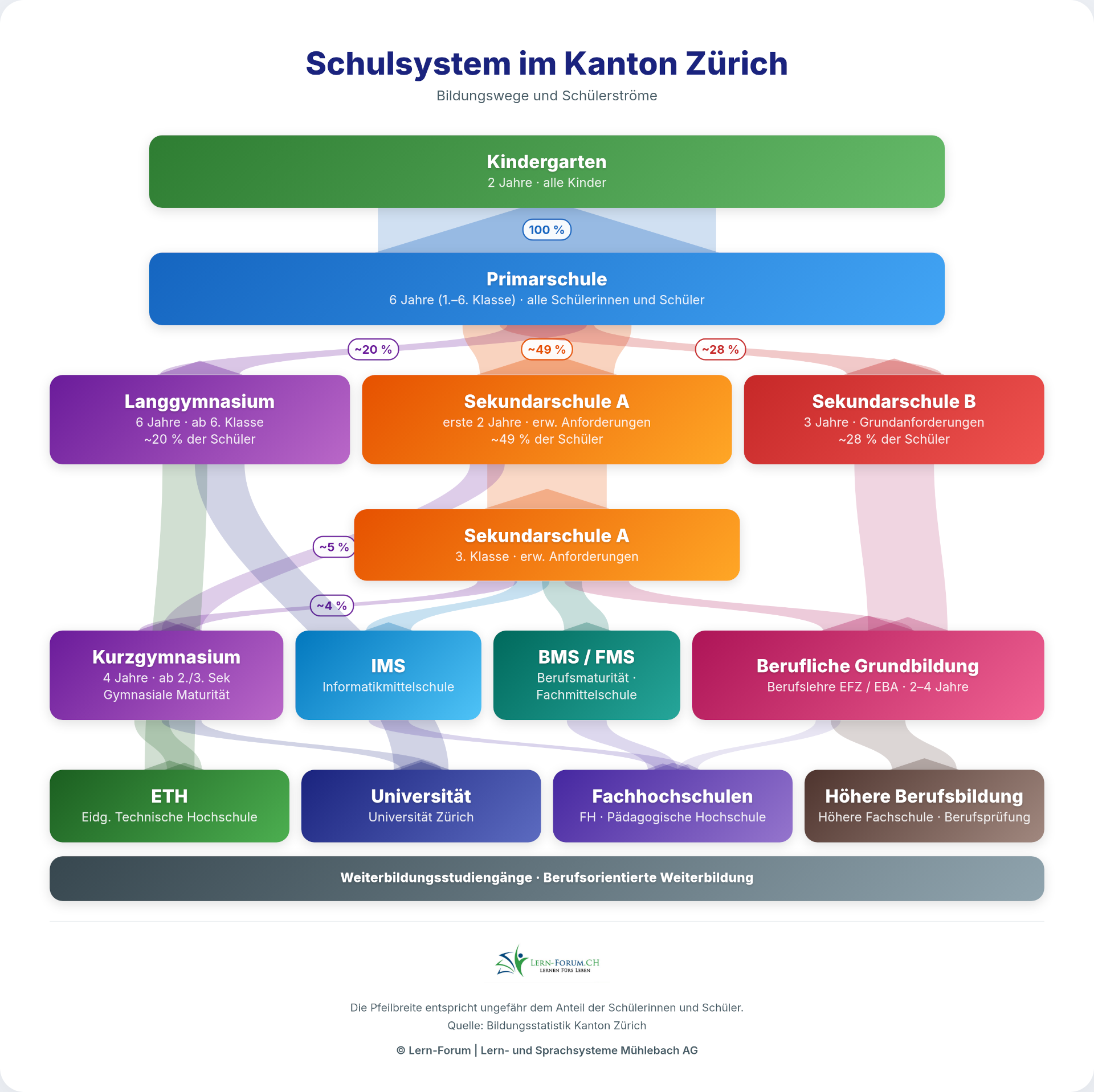
Infographic copyright: Lern-Forum | Lern- und Sprachsysteme Mühlebach AG (use of infographic permitted only with our consent); data source: Education statistics for the canton of Zurich
The individual school levels and school types or qualifications
The Zurich school system can be divided into different levels, with several types of schools or qualifications available at each level.
Early education
Early education precedes kindergarten. It is up to parents to decide whether they want to prepare their children for school through early education. This could involve participating in playgroups or attending family meetings, for example.
Kindergarten/ Lower level
Compulsory schooling in Zurich begins with kindergarten, and applies to all children. This is also referred to as the lower level or entry level. Specifically, all children who have reached the age of 4 by 31 July must start kindergarten at the beginning of the school year (mid-August), which then lasts for two years. In addition to the transition from learning through play to playful learning, teachers already provide age-appropriate lessons in kindergarten.
Primary level
After kindergarten, the Zurich school system continues with primary school, which is divided into lower primary (years 1 to 3) and middle primary (years 4 to 6). Primary school lasts a total of six years.
Secondary level I
After completing the sixth year of primary school, pupils in the canton of Zurich can either transfer to secondary school or to a long-term grammar school. However, transfer to a long-term grammar school is only possible if the pupil has passed the central entrance examination (grammar school entrance examination).
Prepare for the grammar school exam with a grammar school preparation course
Secondary school
Secondary school lasts three years, unless pupils transfer to a short-term grammar school or commercial secondary school (HMS) after the second year of secondary school, in which case they must pass the central entrance examination for both of these secondary schools.
Depending on the municipality, there are two departments (A, B) or three departments (A, B, C) at secondary school, which have different requirements in order to accommodate the different performance levels of the pupils. To register for the BMS BM 1, FMS, HMS, IMS and short grammar school examinations, department A or B is required, in addition to other registration requirements.
Long-term grammar school
The long-term grammar school (academic high school) lasts a total of six years. The first six months are a probationary period. Unlike the short-term grammar school programme, Latin is compulsory at the long-term grammar school for the first two years. In the Zurich school system, however, it is also possible to transfer to grammar school (short-term grammar school) later, after the second or third year of secondary school. It is also possible to transfer to HMS after the second or third year of secondary school.
Secondary level II
Upon completion of the third year of secondary school, pupils in the Zurich school system have the following options in particular:
- Basic vocational training: apprenticeship or apprenticeship and BMS
- Vocational secondary schools: HMS and IMS
- General secondary school: FMS
- Grammar school: short grammar school
Vocational basic education: Apprenticeship or Apprenticeship and BMS (Vocational Secondary School)
On the one hand, after the third year of secondary school, pupils can begin basic vocational training in the form of an apprenticeship; either an apprenticeship for an EBA profession, which lasts two years, or an EFZ apprenticeship, which lasts three to four years. Apprentices learn practical skills in the company where they are trained, while theoretical knowledge is taught at a vocational school. There are over 200 different apprenticeship professions in the canton of Zurich.
In the case of an EFZ apprenticeship, apprentices can attend vocational school as well as vocational baccalaureate school (BMS) during their apprenticeship in order to obtain a vocational baccalaureate (BM 1) in addition to the federal certificate of proficiency (EFZ). There is also the option of attending BMS after the apprenticeship (BM 2) or, with the flex option, completing BMS partly during and partly after the apprenticeship (BM 1 flex). However, to attend BMS, you must pass the central entrance examination.
For pupils who have not yet found an apprenticeship or do not know what career they want to pursue, there are public or private bridge programmes after secondary level I. Public bridge programmes include the vocational preparation year (BVJ) and the pre-apprenticeship. Private bridge programmes include, for example, the preliminary course, the social year, the internship or work placement.
Vocational secondary schools: HMS and IMS
Those who have not already transferred to commercial secondary school (HMS) after the second year of secondary school can also do so after the third year, provided they have passed the relevant entrance examination. HMS is a vocational secondary school that leads to the Federal Certificate of Competence (EFZ) in Commerce and a vocational baccalaureate.
Another vocational secondary school is the IT secondary school (IMS), which can only be transferred to after the third year of secondary school once the entrance exam has been passed. The IMS leads to the EFZ IT specialist qualification and the vocational baccalaureate.
Comprehensive secondary school: FMS
The Specialized secondary school (FMS) is a secondary school offering general education and personal development, where students specialise in a particular field (profile) after completing a foundation year. There are three profiles to choose from: health and natural sciences, education, and communication and information. To attend the FMS, students must first pass the FMS examination.
Secondary school: Short-term grammar school
As with HMS, the following applies to short-term grammar schools: students who have not already transferred to a short-term grammar school after the second year of secondary school can also do so after the third year, provided they have passed the relevant entrance examination. The short-term grammar school lasts four years and, like the long-term grammar school, concludes with the federal grammar school leaving certificate.
Those who did not make it to grammar school during secondary level II can, under certain conditions, take the adult grammar school leaving certificate at the Cantonal Maturity School for Adults (KME) as an adult through adult education.
Tertiary level
At tertiary level, the Zurich school system distinguishes between higher vocational education and universities.
Higher vocational education
After obtaining a Federal Certificate of Competence (EFZ) or a school leaving certificate (FMS, BMS, HMS, IMS, Gymnasium) and, in most cases, relevant professional experience, the path to higher vocational education is open.
Higher vocational education includes, on the one hand, higher technical colleges (HF), which can be completed with an HF diploma (federally recognised). On the other hand, higher vocational education also includes higher technical examinations (HFP) (federal diploma) and professional examinations (BP) (federal professional certificate).
Universities
Universities are divided into universities of applied sciences (FH), universities of teacher education (PH), universities and federal institutes of technology (ETH).
Universities of applied sciences (FH) are open to students who have completed their vocational baccalaureate at a BMS, HMS or IMS or their specialised baccalaureate at an FMS. Those who wish to study at an FH with a grammar school baccalaureate also need one year of professional experience. Both bachelor's and master's degree programmes are offered at FHs.
Teacher training colleges (PH), universities and federal institutes of technology (ETH) are open to pupils who have obtained a grammar school leaving certificate, but also to pupils who have passed the passerelle supplementary examination after obtaining a vocational baccalaureate or specialised baccalaureate. At PH, university and ETH, you can complete a bachelor's and/or master's degree. At universities and ETH, it is also possible to do a PhD/doctorate.
Quaternary level
Finally, the Zurich school system also offers what is known as the quaternary level, with further education and training after vocational training or university studies.
BMS instead of grammar school: Start preparing for BMS now!
Sources
- Gymnasium Preparation 4th Grade (last accessed: March 2, 2026)
- School system (last accessed: March 2, 2026)
- Education system (last accessed: March 2, 2026)
- IDES Dossier | IDES Dossier Private Tuition (Homeschooling) during compulsory schooling: legal framework (last accessed: March 2, 2026)
- Kindergarten (last accessed: March 2, 2026)
- Gymnasium Preparation Zurich - Preparatory courses for every need (last accessed: March 2, 2026)
- Entrance exam for a short-term grammar school (last accessed: March 2, 2026)
- Entrance examination for a commercial secondary school (last accessed: March 2, 2026)
- Which way to go? Brochure on the school system in the Canton of Zurich (last accessed: March 2, 2026)
- Difference between long-term and short-term secondary schools in Zurich - which is better? (last accessed: March 2, 2026)
- Entrance examination for a vocational baccalaureate school (last accessed: March 2, 2026)
- Bridge offers (last accessed: March 2, 2026)
- Entrance exam for a secondary school specializing in computer science (last accessed: March 2, 2026)
- KME. Cantonal High School for Adults (last accessed: March 2, 2026)
- Higher vocational schools (HF) explained briefly (last accessed: March 2, 2026)
- Higher vocational education (last accessed: March 2, 2026)
- BMS Preparation in Zurich (last accessed: March 2, 2026)
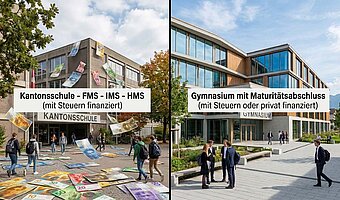
What is the difference between grammar and cantonal school?
In cantons of Zurich and Aargau, a grammar school and a cantonal school are not same thing. Rather, there is a difference between grammar and cantonal school.
Lowest failure rate in probationary period grammar school
Find out here where the failure rate during the probationary period at grammar schools in the Canton of Zurich is lowest, and other selection criteria.

AI increasingly important: Is IMS training up to date?
Here, we explain whether the IMS training at the Zurich Informatics Secondary School is still relevant in light of development of artificial intelligence (AI).
Training quality: Vocational training worse than reputation
The quality of vocational training in Switzerland is heavily criticized; vocational training is worse than its reputation – reports and surveys confirm this.
Rychenberg cantonal school: new arts and sports grammar school
At Rychenberg Cantonal School in Winterthur, a second arts and sports grammar school in the canton of Zurich is set to open in the 2029/2030 academic year.
Switzerland: Early selection in schools - pros and cons
Many cantons in Switzerland are known for the early school selection, often at the age of 12 or 13. Read the arguments for and against here in our article.
Is the Swiss Matura more difficult than the German Abitur?
In this comparison, you'll find the answer whether Swiss Matura or German Abitur is more difficult, and what the difference is between Matura and Abitur.

15 focus subjects at grammar schools 2029/2030 in Zurich
Starting in 2029/2030 school year, 15 focus subjects at grammar schools in Canton Zurich will replace current 13 focus subjects and 6 grammar school profiles.
New grammar school in Zurich: «Kantonsschule Aussersihl»
With Hohlstrasse branch becoming independent as ‘Kantonsschule Aussersihl’ (KAS), Zurich-West gaining new grammar school and a new secondary technical school.
Grammar school graduation quota - canton controls since 2007
Grammar school graduation quota in Canton Zurich is managed by the Department of Education, specifically through the pass rate, various control mechanisms.
