



Artificial intelligence in schools? Artificial intelligence (AI) is already being used in a wide variety of applications and professions, at universities, and even in schools. It is said that the rapid spread of AI is of a similar significance to the spread of printing or the internet.
But if artificial intelligence is so important, shouldn't AI be taught in Swiss schools, possibly even as a separate subject? A model project is already underway at a secondary school in Germany, and there has also been a model project involving artificial intelligence in school teaching in Switzerland.
In the following article, we explore questions such as what artificial intelligence actually is, how artificial intelligence is already being used in Swiss schools today or could be used in the future, what advantages and disadvantages artificial intelligence would have in school lessons, and whether artificial intelligence should even be taught as a separate subject in Switzerland.
Start preparing for grammar school now!
Table of contents
- What is artificial intelligence?
- Artificial intelligence in schools
- AI in school lessons: advantages and disadvantages
- Conclusion
What is artificial intelligence?
The term ‘artificial intelligence’ is not new. It was first mentioned in a research proposal in 1955. Computer scientist John McCarthy wanted to find out the following about artificial intelligence:
‘[...] how to make machines use language, form abstractions and concepts, solve kinds of problems now reserved for humans, and improve themselves.’
Accordingly, artificially intelligent machines are those that master human abilities associated with intelligence, in particular thinking, planning and problem solving.
However, what today's AI models do – such as the widely used ChatGPT – cannot be described as thinking. This is because these AI models are based on statistical models of enormous amounts of data, which has been strongly criticised by opponents of this primarily quantitative approach, such as the late AI researcher Marvin Minsky, who argued that the development of artificial intelligence should focus on cognitive processes, i.e. replicating human thinking rather than merely simulating it.
The fact that statistical AI models have now become mainstream in the AI industry is also due to the power of modern computers in reading huge amounts of data. However, these AI models do not come close to human thinking, as they lack the ability to abstract, cannot draw conclusions and have no connection to factuality, according to AI expert Prof. Gary F. Marcus. Today's AIs are approaching language use but not language comprehension.
How exactly does generative AI work?
What most people today know as artificial intelligence, namely AI text generators such as ChatGPT, Claude and Gemini, AI image generators such as Canva, RunwayML and Midjourney, AI video generators such as Sora and Veo 3, or AI search engines such as Perplexity, is also referred to as generative AI.
But let's start at the beginning: artificial intelligence is the umbrella term for a whole field of different AI models. Generative AI belongs to the so-called transformer models, which are part of deep neural networks (DNN), a subcategory of machine learning (ML). And machine learning is a type of artificial intelligence.
Machine learning involves the use of examples to train an AI model to make its own decisions. Deep neural networks form so-called artificial neural networks to process large amounts of data and learn from it, for example, image recognition or language processing.
Prompt, probability calculation, random generator
Generative AI can independently create new content, including text, images, infographics, videos and even music. Generative AI only needs one input – a so-called prompt – and then produces a suitable output based on the patterns it has learned during training. The prompt is often a pure text input, but can also be an image, video, music sequence or programming code, often combined with a text input.
When creating the output or response, the AI does not follow predefined rules, but calculates the result based on probabilities. The output is therefore the sequence of words that the AI considers most likely based on its training and, in some cases, in combination with live searches on the internet. A random generator is also used as a corrective measure to ensure not always the same answers are produced.
Hallucinations and distortions
Probability calculations of word sequences and random generators are the reason why AI models so often make mistakes in their answers. This is also referred to as hallucinations, where false, invented or misleading information and sources are presented as genuine facts.
In addition, AI models repeatedly adopt distortions, prejudices or stereotypes from the training data, also known as biases. Another problem is that the decision-making process of generative AI models is not transparent; they behave more like a black box, where you don't know how the input was transformed into the output.
What are the benefits of AI in schools?
Artificial intelligence is particularly good at recognising patterns. AI is also very good at creating content based on the data provided to it. There are many possible applications for artificial intelligence. In general, these include the creation and improvement of text, images, graphics, videos, code and music, research (including scientific research), document analysis, translations and the automation of processes, for example through AI agents.
In the following list, we have compiled some of the specific applications of artificial intelligence that are particularly useful in schools:
- Early learning of how to use AI tools in school lessons, particularly to increase productivity in further education and later careers, for example through AI text creation and AI research.
- Personalised learning support by adapting tasks to the performance level of each pupil with the help of AI tools (e.g. simplifying difficult-to-understand texts, making difficult tasks easier, and vice versa).
- Immediate performance feedback through AI tools after pupils submit their work to the AI for review.
- Knowledge acquisition, especially through the ability to ask specific questions.
- Generating ideas for lessons and project work.
However, artificial intelligence has many weaknesses that diminish its usefulness:
- Frequent misinformation (so-called hallucinations), which is why AI responses or AI outputs must always be checked for accuracy.
- Data protection issues: For data protection purposes, it is always necessary to clarify what happens to your own input, in particular whether and where it is stored; it is advisable not to enter any personal data into AI systems.
- Copyright issues: There are many ongoing court cases because the creators of content used to train AI systems feel that their rights have been infringed. As of 5 December 2025, there were 65 copyright lawsuits against AI companies. Recently, for example, OpenAI lost a copyright lawsuit because copyrighted song lyrics were contained in its systems and were output to ChatGPT users when they entered simple prompts.
- Problems with understanding context: AI does not understand context in the same way that humans do. This is why AI has difficulty dealing with irony, for example.
- Complex prompts are often necessary: To compensate for the problem of poor context understanding, you have to provide the AI with as much context as possible in the prompt, i.e. write the prompt as detailed as possible or as detailed as necessary. Depending on the expected output, you have to provide the AI with very precise and differentiated information. This can sometimes be time-consuming, which limits the usefulness of AI.
- Problems with creativity: AI can produce new content, such as new texts, new images and new videos that do not yet exist in this form. However, this is not true creativity, because the new content is based on familiar patterns that the AI has learned during its training; individual parts are simply recombined. Human creativity goes beyond this, for example with the ability to distinguish novel ideas from conventional ones, which ChatGPT-4o has problems with, according to a study.
When should AI models not be used?
Due to the high error rate of AI responses, which can be as high as around 50 per cent, a decision model should be followed to determine whether or not AI should be used for a particular question or application. One such decision model was developed by AI and data management expert Aleksandr Tiulkanov, for example:
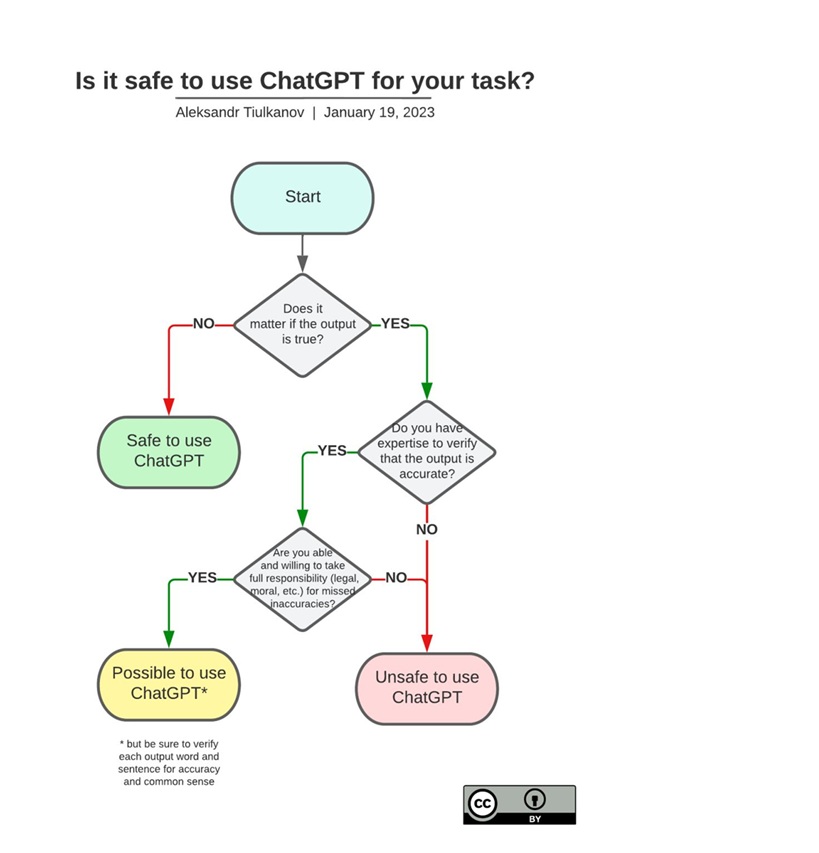
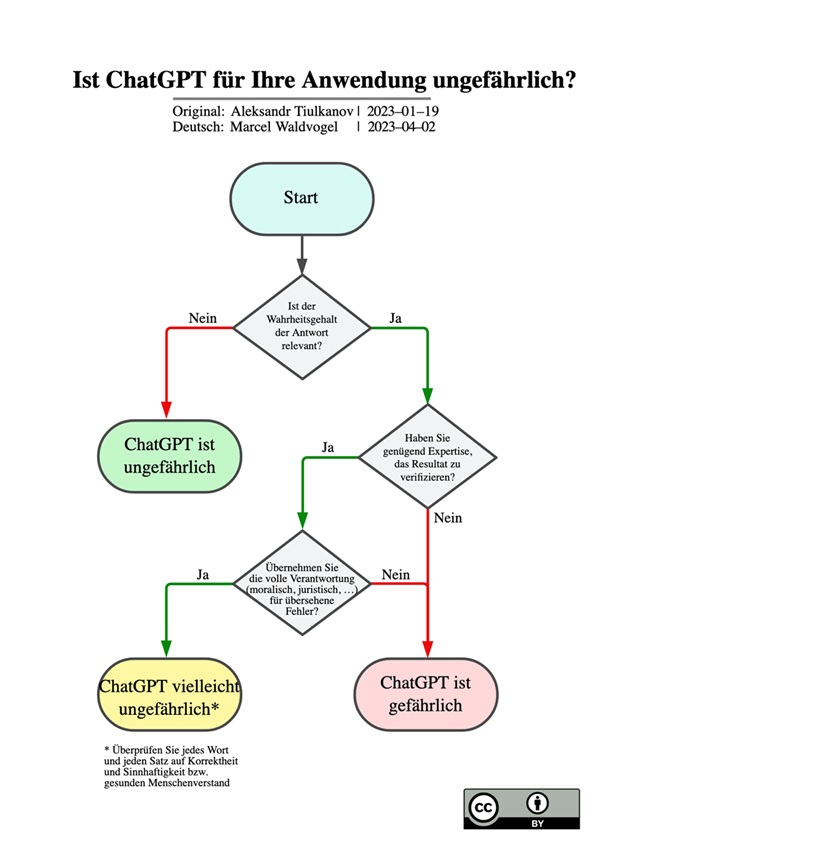
Artificial intelligence in schools
In the early days of the ChatGPT boom at the end of 2022, when a free version was offered to the public, the prevailing opinion was that ChatGPT should be banned from school classrooms. This was because many pupils were already using ChatGPT at an early stage, for example to do their homework or write essays.
Attitudes towards AI tools, including ChatGPT, in education have since changed. Instead of a general ban on artificial intelligence in schools, AI is now viewed in a more nuanced way in many places, and the responsible use of AI tools in schools is encouraged; some schools are even teaching AI already.
Model project ‘AI as a school subject’ in Germany
In Germany, Veldenz Gymnasium in Lauterecken (Rhineland-Palatinate) has been running a model project for a year now, teaching artificial intelligence as a school subject. The aim is to prepare pupils for a future that would be unthinkable without AI. To this end, pupils are taught how to use AI, says Ulrich Königstein, headmaster of Veldenz Gymnasium. Among other things, pupils learn how to create prompts in AI tools so that they produce the desired result. They also learn where artificial intelligence gets its data from and whether the AI's answers can be trusted.
AI in school lessons in Switzerland
A study by education researcher Prof. Dr. Stefan Wolter has found that one in three secondary school pupils already uses AI tools such as ChatGPT on a weekly basis to complete tasks in class or at home.
In the case of translation programmes, over 50 per cent of secondary school pupils use them. The percentages are even higher among grammar school pupils. There, 50 per cent use AI tools such as ChatGPT for schoolwork or homework, and 70 per cent use AI tools for translations. At the pupil level, AI is therefore already widespread in Swiss schools.
However, there is currently no separate subject called ‘artificial intelligence’ in Switzerland. However, Curriculum 21 introduced the subject ‘Media and Computer Science’ which is taught for one hour per week in the 5th and 6th grades of primary school and the 1st and 3rd grades of secondary school in the canton of Zurich. The Zurich curriculum does not mention artificial intelligence in the ‘Media and Computer Science’ module.
However, in 2024, there was already a pilot project in Switzerland that tested the use of artificial intelligence in school lessons, namely at the municipal schools in Zug.
The importance already attached to artificial intelligence in schools in the canton of Zurich is evident, among other things, in the guidelines ‘Artificial Intelligence in Primary Schools’ issued by the Primary School Office of the Canton of Zurich:
- AI is an integral part of society and schools.
- AI should be used by schools as inspiration and a supplement.
- Schools should teach students and teachers about the possibilities, limitations, and functionality of AI.
- Everyone should have access to AI
- Schools must ensure the legally compliant use of AI.
Whether and to what extent AI is incorporated into school lessons in Switzerland currently depends on the individual teacher. There are teachers in Switzerland who already let their pupils work with AI image, video and music generators.
However, as the Tagesanzeiger reports, there are also teachers who are less familiar with AI and who always lag a little behind developments in this field. By the time they have completed further training, there will already be another breakthrough in AI. And then there are those teachers who are so critical of AI that they would prefer to ban it from schools altogether.
In the canton of Solothurn, for example, so-called pedagogical ICT supporters (PICTS) are taking on the role of teachers in AI, where fourth-graders are already receiving AI lessons and learning, among other things, how to write a prompt for generating an image in order to obtain the desired result. But the limitations and dangers of AI are also taught, not only to students, but also to teachers.
In the canton of Zurich, there are also educational and technical ICT support specialists (PICTS and TICTS) who support schools in the digital transformation. The canton of Zurich has even dedicated an entire website to the digital transformation, ICT-Coach, which also provides information on artificial intelligence in schools.
AI at universities, ETH and teacher training colleges
AI has long been incorporated into universities in the form of basic courses on artificial intelligence and its specific applications, for example at HSG, ETH Zurich and the University of Basel.
The ETH Zurich website states:
‘ETH Zurich advocates a proactive approach to the use of generative AI (GenAI) in an educational context and emphasises the responsible use of this technology among students and lecturers.’
ETH Zurich calls on students to learn more about how generative AI (GenAI) works and to explore its potential for creativity, idea generation, personalised learning and coaching. At the same time, students should remain critical of the results produced by AI. To this end, students should consider the limitations of AI, the ethical implications and the potential biases of generative AI.
The Zurich University of Teacher Education (PH Zurich) supports schools and their teachers with courses and internal training programmes on the topic of ‘Artificial Intelligence in Schools’, such as the course ‘Artificial Intelligence in Schools: Focus on Media Education’, which teaches the basics of AI, including ideas for lesson preparation and use in the classroom.
Start your grammar school preparation course now!
Various areas of application for AI in schools
The Swiss Teachers' Association (LCH) has already taken a position on artificial intelligence in schools and recognises both the opportunities and risks of AI systems for the Swiss education system.
In particular, the LCH differentiates between the use of AI in schools according to different areas of application, which we have further differentiated in the following list and in the sections below:
- Learning about AI
- Learning about AI tools
- Learning with AI tools
- Teaching with AI tools
- Assessment with AI tools
- Administration with AI tools
Learning about AI
First and foremost, when it comes to AI in schools, learning about AI is essential. Regardless of whether pupils use AI themselves at school or not, given the prevalence of artificial intelligence, they should definitely learn how today's AI models work, what limitations AI models have, and what legal and ethical issues arise.
Learning about AI tools
There are now a wide variety of AI tools available, including AI text, image, video, music and code generators, as well as AI document analysis tools and AI research tools. However, there is no single AI tool that is perfect for everything. If you want to achieve a specific result with an AI tool, you should rather look for the AI tool that is best suited for that task.
The number of AI tool providers is also growing steadily. The best-known AI tools include the following:
| AI-Tool | Areas of application | Especially suitable |
| ChatGPT | Text and image creation, document analysis, code creation, internet research, and more | Free use of an AI chatbot without having to log in |
| Claude | Text creation, document analysis, code creation, internet research, and more | Text creation and text editing, document analysis |
| Gemini | Text creation, document analysis, code creation, internet research, and more | Image editing |
| Googles KI-Modus | Internet search, text creation, document analysis, code creation, and more | Quick internet searches for current information |
| NotebookLM | Document analysis and document summaries, podcast creation | Analysis and summaries of PDFs |
| Microsoft Copilot | Text and image creation, document analysis, code creation, podcast creation, internet research, and more | Free image generation without login possible |
| Perplexity | Internet Search | Internet search with more reliable sources |
| Consensus | Search engine for compiling key statements from scientific articles | Scientific research |
| Elicit | Search engine for summarizing an answer from the most relevant scientific articles | Scientific research |
| Local Citation Network | Visualization of citation networks | Literature review |
| RunwayML | Image and video creation | Image and video creation using the chat function |
| Midjourney | Image and video creation | Artistically designed images and videos |
| Veo 3 und 3.1 | Video creation | Video creation |
| Sora | Video creation | Video creation |
| Canva | Graphic design, graphic animation, image creation, image resizing, code creation, text creation, translations | Graphic design, graphic animation |
| ElevenLabs | Reading texts aloud | Voice-overs for videos |
| DeepL Write | Text correction, style change | Style change |
| Suno | Music creation | Songs or musical accompaniment |
| DeepL | Translations | Translations from, for example, German to English, French, Italian, Spanish |
| Supertext | Translations | Translations especially into Swiss German (Zurich German, Bernese German) and Romansh |
As mentioned above, a number of copyright lawsuits are currently pending against various AI providers. For example, the German Society for Musical Performing Rights and Mechanical Reproduction Rights (GEMA) has filed a lawsuit against Suno, alleging that Suno used copyrighted songs for training purposes and therefore outputs very similar songs in response to prompt requests.
It is also important to take a close look at what rights you are giving up when using AI. In the case of Suno, for example, when you upload your own compositions, you transfer to Suno the rights to reproduce, modify, distribute and much more.
In addition to the AI tools mentioned above, there are numerous other AI tools, including AI agents that function autonomously and pursue goals independently, such as researching specific topics, scheduling appointments, checking quality standards or making purchases. AI agents do not need to be controlled by constant human instruction.
In school lessons, pupils should definitely learn how to create texts, images, graphics and videos, as well as how to conduct research and analyse documents using common AI tools. This is because all of these skills may become relevant during further education, for example when preparing presentations or writing a scientific thesis.
In addition, AI is already used in many professions, especially to increase productivity, for example for writing business, official and customer correspondence, for translations or for researching internal company databases. Lawyers, for example, use AI to analyse large amounts of data. And in creative professions such as advertising agencies, texts, images, graphics and videos that used to be produced by humans are now created by AI. But even professions such as teaching now use AI tools to create content, as we have seen.
Prompting needs to be learned
The question or command that you enter into an AI tool such as a text generator, image generator or video generator is called a ‘prompt’.
There are different approaches to prompting. For example, you can start with a simple command in the form of a short sentence. If you are not satisfied with the AI's response, you can try to improve the AI's result in the next prompt by providing more precise and/or differentiated information, provided the AI has a chat mode. You repeat this until you are satisfied with the AI's response.
Chat mode greatly simplifies prompting. AI image generators such as RunwayML now also have this chat mode. In chat mode, you can work your way towards the desired result bit by bit by continuously correcting the image generator's intermediate results with new prompts in the chat history until you are satisfied with the generated image.
However, since AI models have difficulty recognising the context of a question, you should provide as many details as possible in the initial prompt before formulating the actual question or instruction. When prompting, the rule is: ‘The more precise the input, the more specific and accurate the result,’ as stated on the ILIAS learning platform of the PH Zurich.
Ideally, you should use a structured prompt, also known as a mega prompt, which addresses several commands to the AI in a single prompt, such as:
- Task:
- Context:
- Style:
- Text length:
- Role description of the AI:
- Target audience:
- Text structure:
- Language:
It is also advisable to store ‘user-defined instructions’ (called ‘Custom Instructions’ in ChatGPT) for the AI models that apply to all prompts in order to obtain more accurate answers, such as the instruction: ‘Please ask me for clarification before responding if one of my prompts is not clear enough.’
With image generators such as Midjourney, for example, you can create additional images in a series in the same style as the first image by creating codes.
Learning to verify AI information
The answers or outputs of AI tools should always be checked for errors, as AIs often provide incorrect information.
In the case of texts, you should check whether the information is plausible. You should also check whether the source references are correct. If you have doubts about the result provided by the AI, you should verify the relevant information by searching Google and/or looking it up on Wikipedia.
For images and videos generated by AI, for example, you should check whether the proportions of people and objects are correct. You should also check whether the details are correctly represented, such as the correct number of fingers on a person or the correct number of wheels on a lorry.
Learning with AI tools
There are now also numerous AI tools that have been developed specifically for learning.
For example, the AI writing tutor FelloFish provides students with feedback on their texts, for example in terms of content and structure, according to the teacher's specifications. Spelling and grammar checks are also part of the feedback.
General AI tools, such as DeepL Write, are also used in schools as AI learning tools to help students learn alternative phrasing and stylistic improvements.
There are high hopes for AI tools in schools in the area of personalised learning, where the AI tool adapts to the performance level of the individual student. Immediate feedback from AI performance reviews is also considered an advantage, especially since it is free of sanctions, as AI does not get annoyed by the student's mistakes.
However, care must be taken to ensure that students do not lose certain basic skills simply because AI can perform certain tasks itself. For example, the full potential of AI tools can only be exploited if you are able to read and write well yourself. This is because good reading and writing skills are essential for successful prompting.
Prof. Dr Marc Eyer, head of the Secondary Level II Institute at the Bern University of Teacher Education, warns, however, that it is not yet known whether AI really promotes learning processes. It could also be that working with AI tools only gives the impression that one is learning something; in that case, AI would merely be a distraction.
Eyer also warns against international tech companies that are constantly developing new AI tools for school teaching. The goal behind these AI tools is not education, but usage time, data acquisition and revenue. These AI tools are about increasing efficiency and avoiding effort. However, education always involves effort, says Dr Wolfgang Spahn, who is working with Eyer to investigate the use of AI tools in schools.
Teaching with AI tools
There are also already some reports from teachers in Switzerland who use AI tools to prepare lessons, for example by using ChatGPT in German lessons to create texts with different levels of difficulty, so that weaker pupils are given texts in easy-to-understand language to practise with and stronger pupils are given texts that are more difficult to understand.
With the AI tool ElevenLabs, teachers sometimes create audio files in a foreign language for pupils to listen to and repeat, with ElevenLabs being able to output different dialects and speaking speeds.
But there are other ways AI can be used in lesson preparation, including the following:
- Creation of worksheets including images and graphics
- Creation of explanatory films
- Creation of accessible teaching materials (such as audio texts describing images for pupils with visual impairments)
Assessment with AI tools
As the Primary School Office of the Canton of Zurich itself states on its website, artificial intelligence can also support teachers in assessing pupils. The Canton of Zurich provides assistance and recommendations in this regard.
Administration with AI tools
AI tools can also be used to support administrative tasks in schools, including in the following areas:
- Parent communication: for example, AI-generated invitations to parents' evenings and letters to parents in different languages
- Timetabling
- Data protection-compliant transcription of meetings, parent-teacher conferences and other events
AI in school lessons: advantages and disadvantages
But back to our original question: should AI be taught in schools? What are the advantages and disadvantages of teaching AI in schools?
Advantages of artificial intelligence in schools
The advantages of artificial intelligence in school teaching include the following:
- Mastering AI tools must be learned
- Preparation for education (apprenticeships, universities), as AI skills are already desirable at universities today
- Preparation for careers, as AI tools are already used in a variety of professions
- Possibility of personalised learning
- Inclusive applications
Disadvantages of artificial intelligence in schools
The disadvantages of artificial intelligence in school teaching include the following:
- Risk of loss of motivation, for example due to discouragement of pupils with regard to their own problem-solving skills and feelings of inferiority
- Risk of motivation traps, because pupils no longer see the point in learning something that AI can do (such as learning foreign languages)
- Risk of not learning the associated skills, such as perseverance, stress tolerance and a sense of duty, due to a lack of knowledge acquisition
- Data protection violations due to the unauthorised use of personal data in connection with AI
- Social and emotional interaction, for example through facial expressions and gestures, is important for children to learn teamwork, conflict resolution and empathy, which would be lost with AI
Conclusion
Artificial intelligence has long since arrived in schools, among pupils, teachers, administrators and, in some cases, even as part of the lessons. What's more, AI tools will play an increasingly important role in digital applications in the future and will be used in more and more professions. The question is therefore no longer whether schools should teach AI, but in what form: as a separate subject or as subject-specific sub-lessons within existing subjects?
Curriculum 21 already includes a subject called ‘Media and Computer Science’, which is taught in the canton of Zurich in the 5th and 6th grades of primary school and the 1st and 3rd grades of secondary school for one hour per week. However, as the area of ‘artificial intelligence’ is not mentioned at all in the Zurich curriculum in the ‘Media and Computer Science’ module, the curriculum would need to be expanded accordingly.
Instead of having a separate subject called ‘Artificial Intelligence’, the field of AI could simply be included in the ‘Media and Computer Science’ module. Given the complexity and diversity of AI tools and the topic of AI itself, it would be necessary to determine whether to increase the number of weekly hours, e.g. by teaching an extended module on ‘Media, Computer Science and AI’ with two hours per week. In addition, AI tools should be taught in the respective subjects of German, mathematics, etc. as part of a lesson for subject-specific application.
In order to master common AI tools in the areas of text, image and video creation as well as research, one of the central learning objectives when dealing with artificial intelligence must be for students to learn how to prompt correctly. At the same time, students must learn to always critically question the answers or results provided by AI, whether the information output by AI is correct or incorrect. Any doubts should be dispelled by conducting a Google search and/or comparing the information with Wikipedia, although even Wikipedia has now been found to contain articles that are at least partially AI-generated – so vigilance is required there too. If you have no expertise in a particular area, you should refrain from using AI, according to Aleksandr Tiulkanov's decision-making model.
In addition, students must learn that not everything can be done faster with AI if it takes just as long or longer to check the AI response than to independently research and create the desired content and/or if prompting is too time-consuming in a specific case because the prompt would have to be too detailed or too many prompts would have to be created.
But doesn't the increasing penetration of AI into the school system carry the risk that teachers will eventually be replaced by artificial intelligence? The Swiss Teachers' Association LCH sees no danger here and believes that human teachers will not be replaced by AI. The LCH lists ten arguments for this thesis, including the role model function of teachers, emotional intelligence, the complexity of teaching and learning processes, learning as a social process, data quality, creativity and the diversity of human thinking.
Given the rapid advances in AI tools, it is important to keep teaching students in schools about the latest AI tools. However, as these AI tools often come at a cost, schools need to develop an AI strategy to always purchase licences for the AI tools that are most relevant at any given time.
This also poses a threat to equal opportunities in AI education if schools do not give students access to the most relevant paid AI tools. Students from wealthy families could have an advantage if they have access to the most relevant paid AI tools at home or on their own smartphones, while students from poorer families are excluded from using these AI tools because their parents cannot afford them.
Mastering AI tools will not only determine how well you perform in school, apprenticeships and higher education, but also how productive you are in many existing professions. It is also likely that entirely new professions will emerge in the field of artificial intelligence, for which it will be a great advantage to have been taught about artificial intelligence and AI tools at an early stage in school.
Prepare for the grammar school entrance exam now with our courses
Sources
- Gymnasium Preparation Zurich - Preparatory courses for every need (last accessed: 5.1.2026)
- A proposal for the dartmouth summer research project on artificial intelligence (last accessed: 5.1.2026)
- Artificial Intelligence: Practical Tips for Using AI in the Classroom (last accessed: 5.1.2026)
- AI expert Marcus: What ChatGPT produces, is authoritative bullshit (last accessed: 5.1.2026)
- Wikipedia entry about Gary Marcus (last accessed: 5.1.2026)
- ICT Coach - Artificial Intelligence (last accessed: 5.1.2026)
- Category: Map of AI copyright lawsuits (last accessed: 5.1.2026)
- First landmark AI ruling in Europe: GEMA prevails against OpenAI (last accessed: 5.1.2026)
- The paradox of creativity in generative AI: high performance, human-like bias, and limited differential evaluation (last accessed: 5.1.2026)
- Almost every second AI answer is faulty (last accessed: 5.1.2026)
- Website of Aleksandr Tiulkanov (last accessed: 5.1.2026)
- Post by Aleksandr Tiulkanov on LinkedIn (last accessed: 5.1.2026)
- Marcel Waldvogel: Is ChatGPT safe for your application? (last accessed: 5.1.2026)
- Artificial Intelligence in Schools: A Guide to the State of Research and Practice (last accessed: 5.1.2026)
- School of the future: How AI is modernizing everyday school life in the western Palatinate (last accessed: 5.1.2026)
- Interview with an education researcher: Professor, when will you be replaced by AI? "I'll retire before then." (last accessed: 5.1.2026)
- Primary school (last accessed: 5.1.2026)
- Introduction of Media and Computer Science in the 1st and 3rd grades of secondary school from the 2019/20 school year onwards, checklist for school principals (last accessed: 5.1.2026)
- Module Media and Computer Science (last accessed: 5.1.2026)
- Zug draws positive conclusions after AI project in schools (last accessed: 5.1.2026)
- Artificial intelligence in elementary school (last accessed: 5.1.2026)
- Chatbots in primary school: Even ten-year-old children are chatting with AI – overwhelming teachers and parents. (last accessed: 5.1.2026)
- Digital transformation (last accessed: 5.1.2026)
- Welcome to the ICT Coach (last accessed: 5.1.2026)
- University graduates without work: Does AI play a role? (last accessed: 5.1.2026)
- AI in the field of teaching and learning (last accessed: 5.1.2026)
- Artificial intelligence in schools (last accessed: 5.1.2026)
- Artificial intelligence in schools: Focus on media literacy (last accessed: 5.1.2026)
- Position paper LCH, Artificial Intelligence in Schools: Seizing Opportunities, Mastering Challenges (last accessed: 5.1.2026)
- ChatGPT (last accessed: 5.1.2026)
- Claude (last accessed: 5.1.2026)
- Gemini (last accessed: 5.1.2026)
- Google's AI Mode (last accessed: 5.1.2026)
- NotebookLM (last accessed: 5.1.2026)
- Microsoft Copilot (last accessed: 5.1.2026)
- Perplexity (last accessed: 5.1.2026)
- Consensus (last accessed: 5.1.2026)
- Elicit (last accessed: 5.1.2026)
- Local Citation Network (last accessed: 5.1.2026)
- RunwayML (last accessed: 5.1.2026)
- Midjourney (last accessed: 5.1.2026)
- Veo 3 and 3.1 (last accessed: 5.1.2026)
- Sora (last accessed: 5.1.2026)
- Canva (last accessed: 5.1.2026)
- ElevenLabs (last accessed: 5.1.2026)
- DeepL Write (last accessed: 5.1.2026)
- Suno (last accessed: 5.1.2026)
- DeepL (last accessed: 5.1.2026)
- Supertext (last accessed: 5.1.2026)
- AI meets copyright – Why the current GEMA lawsuits are groundbreaking for creatives and companies (last accessed: 5.1.2026)
- Plagiarism using artificial intelligence: GEMA sues AI company Suno for copyright infringement (last accessed: 5.1.2026)
- Suno rights for musicians: What you lose when you upload your songs (last accessed: 5.1.2026)
- Creating with Chat Mode | Runway Academy (last accessed: 5.1.2026)
- ChatGPT is overrated. Here’s what to use instead. (last accessed: 5.1.2026)
- ILIAS - Learning platform of the Zurich University of Teacher Education, AI Wiki, Prompts for image generators (last accessed: 5.1.2026)
- ILIAS - Learning platform of the Zurich University of Teacher Education, AI Wiki, Prompts for text generators (last accessed: 5.1.2026)
- Learning support with ChatGPT Mega-Prompts? Initial thoughts on AI as a writing tutor (last accessed: 5.1.2026)
- ChatGPT Custom Instructions (last accessed: 5.1.2026)
- Artificial intelligence in primary education: Opportunities, challenges, perspectives (last accessed: 5.1.2026)
- The classroom of the future - AI in schools: Education or employment? (last accessed: 5.1.2026)
- Made-up sources: How chatbots are poisoning Wikipedia (last accessed: 5.1.2026)
Lowest failure rate in probationary period grammar school
Find out here where the failure rate during the probationary period at grammar schools in the Canton of Zurich is lowest, and other selection criteria.

AI increasingly important: Is IMS training up to date?
Here, we explain whether the IMS training at the Zurich Informatics Secondary School is still relevant in light of development of artificial intelligence (AI).

Training quality: Vocational training worse than reputation
The quality of vocational training in Switzerland is heavily criticized; vocational training is worse than its reputation – reports and surveys confirm this.
Rychenberg cantonal school: new arts and sports grammar school
At Rychenberg Cantonal School in Winterthur, a second arts and sports grammar school in the canton of Zurich is set to open in the 2029/2030 academic year.
Switzerland: Early selection in schools - pros and cons
Many cantons in Switzerland are known for the early school selection, often at the age of 12 or 13. Read the arguments for and against here in our article.
Is the Swiss Matura more difficult than the German Abitur?
In this comparison, you'll find the answer whether Swiss Matura or German Abitur is more difficult, and what the difference is between Matura and Abitur.
15 focus subjects at grammar schools 2029/2030 in Zurich
Starting in 2029/2030 school year, 15 focus subjects at grammar schools in Canton Zurich will replace current 13 focus subjects and 6 grammar school profiles.

New grammar school in Zurich: «Kantonsschule Aussersihl»
With Hohlstrasse branch becoming independent as ‘Kantonsschule Aussersihl’ (KAS), Zurich-West gaining new grammar school and a new secondary technical school.
Grammar school graduation quota - canton controls since 2007
Grammar school graduation quota in Canton Zurich is managed by the Department of Education, specifically through the pass rate, various control mechanisms.
Preparatory institutes alarmed: Sec school pupils know nothing
Exam preparation institutes such as Lern-Forum sounding alarm: Secondary school students have significant gaps in knowledge of math and in French vocabulary.
