


Second-chance education, university studies, a well-paid job as a lawyer or doctor; that sounds appealing at first. But is it financially worthwhile to complete your grammar school diploma through second-chance education as an adult, then undertake the long university studies, and only then start your dream job in your mid-thirties?
In the following article, we explore the question of whether it is worthwhile to pursue a higher-paying career by obtaining an adult grammar school diploma (second-chance education) and completing university studies, or whether it would be better to remain in your current profession and pursue a career there.
Experts recommend: Start preparing for grammar school early on!
Table of contents
- What does "second chance education" mean?
- Comparison of three career development scenarios
- Conclusion - Second-chance education studies
What does "second chance education" mean?
The term “second-chance education” refers to educational programs in which adults can obtain a school leaving certificate and/or vocational qualification that they did not acquire in their younger years during their normal education at school, in an apprenticeship, or at university.
Among other things, the following educational qualifications can be obtained if the relevant requirements are met:
- Apprenticeship certificate EBA or EFZ
- Vocational baccalaureate (BMS 2)
- Grammar school diploma (adult baccalaureate)
Attend a BMS preparation course now!
Second-chance education: Requirements for adult grammar school diploma
Since we want to explore the question of whether it is worthwhile to complete a university degree via adult education, we are particularly interested in the path from the adult grammar school diploma to university studies, although in theory it is also possible to gain admission to university via the vocational baccalaureate and the additional Passerelle supplementary examination.
In the canton of Zurich, the adult grammar school diploma, i.e., the grammar school diploma through adult education, can be obtained at the Cantonal Grammar School for Adults (KME). However, in order to be admitted to the KME—either full-time or part-time—you must first pass the entrance exam, for which you will only be admitted if you meet the following requirements:
- Completed secondary school A or B
- Knowledge of three years of secondary school material (in accordance with the Zurich canton curriculum)
- Completed vocational training or at least three years of regular professional activity
- Good knowledge of German
- Maximum age of 40 upon admission to the KME
Once you have passed the entrance exam for the Cantonal Grammar School for Adults (KME), you can attend the KME either full-time or part-time. The full-time course lasts 6 semesters, while the part-time course lasts 7 semesters until you obtain your grammar school diploma, provided you pass the exam.
Comparison of three career development scenarios
After completing the three- or three-and-a-half-year grammar school program for adults, students still have a three-year bachelor's degree program ahead of them, and those who want to pursue a master's degree usually have to invest at least another year and a half.
In total, therefore, it takes at least 7.5 years to complete a university degree via adult education. In the following sections, we compare three different career development scenarios to show what the additional effort involved in adult education means in financial terms:
- Scenario 1: Career without a grammar school diploma or university degree (using the example of an EFZ-certified commercial clerk – services and administration in a law firm)
- Scenario 2: Adult grammar school diploma, university degree, employee (using the example of a lawyer)
- Scenario 3: Adult grammar school diploma, university degree, employee, co-owner of a company (using the example of a law firm partner)
In these three scenarios, the person in question is 28 years old, lives in the city of Zurich, completed an apprenticeship as an EFZ-certified commercial clerk (service and administration in law) by the age of 28, currently works in this profession as a commercial clerk in a law firm in Zurich, but is considering catching up on their grammar school diploma through adult education and then studying law at the University of Zurich in order to work as a lawyer. The person concerned does not receive any support from their parents or scholarships in any of the three scenarios.
Scenario 1: Career without grammar school diploma and without university degree
In the first scenario, we look at the financial development of an EFZ-certified commercial clerk (services and administration in law) who, without a grammar school diploma or university degree, pursues a career as a commercial clerk in a law firm in the city of Zurich.
As a 28-year-old, he earns CHF 6,284 per month (median income, gross, including 13th month's salary) as a junior commercial clerk in a law firm in Zurich. As a senior clerk, he then earns CHF 6,647 per month at the age of 32. At the age of 40, they become a team leader and their salary increases to CHF 8,216. At the age of 50, they earn CHF 9,174 in this position due to their success and experience, and until retirement at the age of 65, their income stagnates at this level due to the employer's assumption of a decline in productivity as a result of age.
In the following table, we have summarized the income development over time in a clear overview:
| Age period | Annual income (gross, including 13th month salary) | Monthly salary (gross, including portion of 13th month salary) | Job-Situation |
| 28-31 | 75’408 CHF | 6’284 CHF | Junior Clerk (KV) |
| 32-39 | 79’764 CHF | 6’647 CHF | Senior Clerk (KV) |
| 40-49 | 98’592 CHF | 8’216 CHF | Team Leader (KV) |
| 50-59 | 110’088 CHF | 9’174 CHF | Success and experience bonus |
| 60-65 | 110’088 CHF | 9’174 CHF | Wage stagnation due to alleged productivity decline in old age |
Source: Salarium - Statistical salary calculator 2022 from the Federal Statistical Office (FSO)
For later comparison with the other scenarios, we can now calculate the lifetime income:
| Age period | Gross income (gross, including 13th month salary) |
| 28-31 | 4 x 75’408 CHF = 301’632 CHF |
| 32-39 | 8 x 79’764 CHF = 638’112 CHF |
| 40-49 | 10 x 98’592 CHF = 985’920 CHF |
| 50-59 | 10 x 110’088 CHF = 1’100’880 CHF |
| 60-65 | 5 x 110’088 CHF = 550’440 CHF |
| Total income over 37 years of employment: | 3’576’984 CHF |
Since there were no additional training costs and no debts had to be incurred for further training, the basic income generated over 37 years corresponds to the theoretically accumulated assets: CHF 3,576,984. Theoretical insofar as all living expenses such as rent (possibly mortgage) and food, but also health insurance, taxes, travel, hobbies, culture, etc. had to be paid from the basic income.
Scenario 2: Adult grammar school diploma, university studies, employee
In the second scenario, we look at the financial development of the same person as in scenario 1, i.e., someone who has completed vocational training as a commercial clerk but decided at the age of 28 to obtain their grammar school diploma through adult education, then studied law, and finally went on to work as a lawyer in a law firm.
Anyone who decides to take the full-time course at the Cantonal Grammar School for Adults (KME) in order to obtain the adult grammar school diploma must expect to spend six semesters, i.e., three years. For Swiss citizens and holders of a B or C residence permit who have been living and paying taxes in the canton of Zurich for at least two years, the KME is free of charge. Students from other cantons must pay tuition fees of CHF 20,000-20,400 per year.
Those who do not make it to KME or do not want to prepare for the school-based Maturity examination there can also attend a private grammar school for adults, but these are subject to a fee. The costs for private Maturity schools can be around CHF 30,000 for the three-year preparation period. If the non-state school is recognized by the canton, the school-based grammar school exam can be taken at the respective school. Otherwise, the grammar school exam is taken externally at the Swiss Matura Commission (external matura). Alternatively, you can prepare for the adult grammar school exam through self-study.
The law degree at the University of Zurich following the grammar school exam (Matura) takes four and a half years. It consists of a bachelor's degree and a subsequent master's degree. The Bachelor of Law (B Law) UZH takes six semesters, or three years, at the university, and the Master of Law UZH with a focus on legal practice usually takes three semesters, or one and a half years, at the University of Zurich.
After completing your law studies, you must complete a one-year legal traineeship before you are allowed to take the bar exam. The salary during this legal traineeship at a normal Zurich law firm is around CHF 5,000 per month.
Opportunity costs of adult high school diploma, university studies, legal traineeship
In order to calculate the financial impact of scenario 2 compared to scenario 1, we must first determine the opportunity costs incurred by completing adult high school (3 years), university studies (four and a half years), and a legal traineeship (1 year), i.e., a total of 8.5 years of training to obtain a law license (admission to the bar). The opportunity costs are the lost income from giving up full-time employment as a certified commercial clerk.
From the third semester onwards, it is no longer possible to work alongside the KME while preparing for the Matura in a full-time course. For the period from the first and second semesters at the KME and during the period of study at the University of Zurich, we assume part-time work of 36 percent as an EFZ-certified commercial clerk (approximately 15 hours/week).
First, we calculate the lost income from the full-time employment as an EFZ-certified commercial clerk during the 8.5-year training period, offsetting the income from part-time employment as an EFZ-certified commercial clerk during KME and UZH training as well as the income from the legal traineeship:
| Item | Calculation | Income |
| Lost full-time salary as an EFZ-certified commercial clerk: | 75408 CHF x 4 (years) = 301’632 CHF 79’764 CHF x 4,5 (years) = 358’938 CHF | - 660’570 CHF |
| Income from part-time employment as a certified commercial apprentice during KME and UZH: | 27’147 CHF x 5,5 (years) = 149’309 CHF | 149’309 CHF |
| Income from salary for legal traineeship: | 60’000 CHF x 1 (years) = 60’000 CHF | 60’000 CHF |
| Lost full-time wages, taking into account part-time wages and legal traineeship wages: | 451’261 CHF | |
Education costs
Education costs must also be calculated.
Those who do not make it to KME or do not want to go there and instead prepare for the adult grammar school diploma (second-chance education) by attending a private grammar school must expect to pay CHF 30,000 in school fees for the three-year grammar school program.
At the University of Zurich, tuition fees for law studies amount to CHF 720 per semester, i.e., CHF 6,480 for four and a half years (9 semesters). Teaching materials cost an additional CHF 300 per semester, bringing the total cost of books and other teaching materials to CHF 2,700 over the course of nine semesters.
In the worst-case scenario, which we have used in our calculation, the cost of education for the adult grammar school exam and law studies is CHF 39,180.
Debt interest
Given the extremely high rents in the city of Zurich, where a room in a shared apartment can easily cost CHF 1,500 per month, students without parental support or scholarships usually have to take out a loan to cover the high cost of living. These costs cannot be financed by a part-time job alone. In addition to rent, there are at least CHF 1,300 in other costs such as food, travel, and insurance.
And that's not even including vacations; as a student, you should see something of the world. In the city of Zurich, it is therefore advisable for students to budget CHF 3,000 per month to make ends meet, especially adult students, as adults are accustomed to higher standards than young people who are used to living modestly.
During the 7.5 years spent at adult grammar school and the University of Zurich, living expenses amount to CHF 270,000. However, working part-time at 36 percent as a certified commercial clerk, you would only earn CHF 149,309 during this period, especially since you cannot work part-time for the full 7.5 years. The difference of CHF 120,691 must therefore be covered by taking out a loan. In the case of a personal loan, the interest rates range from approximately 4 to 9 percent, depending on the provider and credit rating. We estimate 7 percent as the upper average.
If you repay the CHF 120,691 loan over 20 years with a monthly installment of around CHF 1,000 to repay the loan amount and interest, the total interest burden is around CHF 100,000.
Income in professional life after graduation
We estimate the income development of a lawyer in the city of Zurich as follows:
| Age period | Annual income (gross, including 13th month salary) | Monthly salary (gross, including portion of 13th month salary) | Job-Situation |
| 36-42 | 113’724 CHF | 9’477 CHF | Junior Associate Lawyer |
| 43-49 | 125’340 CHF | 10’445 CHF | Senior Associate Lawyer |
| 50-59 | 134’412 CHF | 11’201 CHF | Counsel |
| 60-65 | 134’412 CHF | 11’201 CHF | Wage stagnation due to alleged productivity decline in old age |
Source: Salarium - Statistical salary calculator 2022 from the Federal Statistical Office (FSO)
For later comparison with the other scenarios, we can now calculate the lifetime income:
| Age period | Gross income (gross, including 13th month salary) |
| 36-42 | 7 x 113’724 CHF = 796’068 CHF |
| 43-49 | 7 x 125’340 CHF = 877’380 CHF |
| 50-59 | 10 x 134’412 CHF = 1’344’120 CHF |
| 60-65 | 5 x 134’412 CHF = 672’060 CHF |
| Total income over 29 years of employment: | 3’689’628 CHF |
From the total income of CHF 3,689,628 earned over 29 years of employment, the lost full-time salary must be deducted, taking into account the part-time salary and the salary from the legal traineeship between the ages of 28 and 35, i.e. CHF 451,261, the training costs of CHF 39,180 and the total interest burden of CHF 100,000 must be deducted in order to calculate the assets theoretically accumulated over 37 years.
| Total income over 29 years of employment: | 3’689’628 CHF |
| Lost full-time wages, taking into account part-time wages and legal traineeship wages, during the age period 28-35: | - 451’261 CHF |
| Education costs for adult grammar school diploma and university studies: | - 39’180 CHF |
| Total interest burden because of debts: | - 100’000 CHF |
| Theoretically accumulated assets in the age range 28-65 in scenario 2: | 3’099’187 CHF |
As a reminder, the theoretical assets accumulated in scenario 1 (i.e., a career as an EFZ-certified commercial clerk without a grammar school diploma or university degree) in the same age range of 28–65 amounted to CHF 3,576,984.
Despite later working as a lawyer, obtaining an adult grammar school diploma and a university degree results in a loss of assets amounting to CHF 477,797 compared to a career as an EFZ-certified commercial clerk without a grammar school diploma or university degree.
Please also read our article “High income without a university degree thanks to the dual education system”.
In addition to the loss of CHF 477,797, there are other disadvantages if you attend grammar school at the age of 28 as part of a second-chance education program, then study law and only start your new career at the age of 36 instead of continuing to work in your original EFZ profession:
- Years of financial and psychological stress due to debt reduction
- Fewer contributions to the pension fund
- Sacrificing life plans (such as having children or buying a house/apartment) during the 8.5 years of high school, university, and legal traineeship
- Sacrificing hobbies and other leisure activities due to the double burden of school/university and part-time work
Scenario 3: Adult grammar school diploma, university studies, employee, company co-owner
In the third scenario, we look at the financial development of a lawyer who obtained their grammar school diploma through adult education, then completed their law studies, finally worked as a lawyer in a law firm, and then became a partner in the firm, i.e., a co-owner of the law firm. However, this scenario is only realistic for 10 to 15 percent of lawyers.
Income in professional life after graduation
We estimate the income development of a lawyer who becomes a partner in a law firm in the city of Zurich as follows:
| Age period | Annual income (gross, including 13th month salary) | Monthly salary (gross, including portion of 13th month salary) | Job-Situation |
| 36-42 | 113’724 CHF | 9’477 CHF | Junior Associate Lawyer |
| 43-49 | 125’340 CHF | 10’445 CHF | Senior Associate Lawyer |
| 50-59 | 174’564 CHF | 14’547 CHF | Partner |
| 60-65 | 174’564 CHF | 14’547 CHF | Wage stagnation due to alleged productivity decline in old age |
Source: Salarium - Statistical salary calculator 2022 from the Federal Statistical Office (FSO)
For later comparison with the other scenarios, we can now calculate the lifetime income:
| Age period | Gross income (gross, including 13th month salary) |
| 36-42 | 7 x 113’724 CHF = 796’068 CHF |
| 43-49 | 7 x 125’340 CHF = 877’380 CHF |
| 50-59 | 10 x 174’564 CHF = 1’745’640 CHF |
| 60-65 | 5 x 174’564 CHF = 872’820 CHF |
| Total income over 29 years of employment: | 4’291’908 CHF |
Here too, the total income of CHF 4,291,908 earned over 29 years of professional life must be reduced by the lost full-time salary, taking into account the part-time salary and the salary from the legal traineeship between the ages of 28 and 35, i.e. CHF 451,261, the training costs of CHF 39,180 and the total interest burden of CHF 100,000, in order to calculate the theoretical assets accumulated over 37 years:
| Total income over 29 years of employment: | 4’291’908 CHF |
| Lost full-time wages, taking into account part-time wages and legal traineeship wages, during the age period 28-35: | - 451’261 CHF |
| Education costs for adult grammar school diploma and university studies: | - 39’180 CHF |
| Total interest burden because of debts: | - 100’000 CHF |
| Theoretically accumulated assets in the age range 28-65 in scenario 3: | 3’701’467 CHF |
Compared to the theoretical assets accumulated in scenario 1 (i.e., a career as an EFZ-certified commercial clerk without a grammar school diploma or university degree), which amounted to CHF 3,576,984 over the same age period, a career in adult education, culminating in a position as a partner in a law firm, results in an increase in assets of CHF 124,483. That is not much, considering all the effort involved in pursuing a second-chance educational path.
Conclusion - Second-chance education studies
Financially speaking, adult grammar school graduation (second-chance education) and then university studies are never really worthwhile. As a rule, you will suffer a financial loss if you study through second-chance education.
Only if you later work in a profession and position where you earn significantly more money than you would have done with the first educational path can you make a small profit compared to the first educational path. In the case of a lawyer, however, this is usually only the case if you make it to partner. At CHF 124,483, the financial gain as a partner lawyer is not great compared to a career as an EFZ-certified commercial clerk.
Further disadvantages of adult grammar school diploma
In addition, the years of stress involved in paying off debts incurred during grammar school and college have a negative impact. You also have to accept losses in your pension fund. Furthermore, your life plans are pushed back by 8.5 years, such as starting a family and/or buying your own home (if one can afford it at all). Giving up hobbies and other leisure activities also has a negative impact, as the double burden of school/university and a part-time job does not leave much time for anything else.
Nowadays, a career as an academic no longer automatically brings with it higher social prestige, as there are more and more academics, meaning that they are no longer anything special. And working conditions are not necessarily better in academic professions; there is also a lot of pressure to perform well in these fields.
Returning to education is therefore only worthwhile for non-material reasons, because you much prefer the profession you learned through continuing education to your original profession.
Better to go straight to university or via BMS
Anyone who knows at a young age that they want to pursue a career that requires a university degree should take the direct route, i.e. either via the long-term or short-term grammar school to obtain a grammar school diploma and then go straight on to university.
Alternatively, you could take the route via an apprenticeship and vocational baccalaureate school (BMS) and then take the Passerelle supplementary exam, which enables you to study at a university, ETH or teacher training college. However, this route is usually only possible with financial support from parents or scholarships, as there is no time to earn money alongside the one-year full-time preparation for the Passerelle supplementary exam.
All in all:
If possible, you should avoid the route of taking the adult grammar school diploma to study at university through second-chance education, as it usually involves both significant financial and non-material losses.
Start preparing for grammar school now!
Sources
- Gymnasium preparation, 4th grade (last accessed: 21.1.2026)
- Second-chance education in Switzerland: Pathways to qualifications for adults (last accessed: 21.1.2026)
- Registration FMS | BMS (last accessed: 21.1.2026)
- KME Cantonal Grammar School for Adults (last accessed: 21.1.2026)
- KME - Requirements for admission to the entrance examination (last accessed: 21.1.2026)
- Commercial clerk (service and administration law firm) EFZ (last accessed: 21.1.2026)
- Wikipedia: Median income (last accessed: 21.1.2026)
- KME - Costs (last accessed: 21.1.2026)
- biz: Grammar school diploma via the second-chance educational pathway (last accessed: 21.1.2026)
- Recognized non-state secondary schools (last accessed: 21.1.2026)
- High school diploma for adults, studying without a grammar school diploma (last accessed: 21.1.2026)
- Law / Jurisprudence, Bachelor UH, University of Zurich UZH (last accessed: 21.1.2026)
- University of Zurich - Faculty of Law - Master's (last accessed: 21.1.2026)
- Lawyer search: Training and supervision (last accessed: 21.1.2026)
- Bernese legal trainees receive modest wages (last accessed: 21.1.2026)
- KME - Grammar School Diploma (last accessed: 21.1.2026)
- UZH: Fees and contributions for studying (last accessed: 21.1.2026)
- UZH: Study Financing (last accessed: 21.1.2026)
- High income without a university degree thanks to the dual education system (last accessed: 21.1.2026)
- Federal Statistical Office (FSO): Salarium Statistical Salary Calculator (last accessed: 21.1.2026)
- More unemployed academics: trend no cause for concern (last accessed: 21.1.2026)
- Gymnasium Preparation Zurich - Preparatory courses for every need (last accessed: 21.1.2026)
Gymiquote Zürich wird seit 2007 vom Kanton gesteuert
Die Gymiquote im Kanton Zürich wird von der Bildungsdirektion Zürich gesteuert, und zwar über die Bestehensquote mit Hilfe verschiedener Steuerungs-Mechanismen.

Vorbereitungs-Institute alarmiert: Sek-Schüler können nichts
Prüfungsvorbereitungs-Institute wie das Lern-Forum alarmiert: Sek-Schüler haben dramatische Wissenslücken in Mathematik Sek 1 und im Französisch-Wortschatz.
Resultate Gymiprüfung 2026 im Kanton Zürich
Resultate der Gymiprüfung 2026, Mitte Mai 2026 vom Kanton Zürich veröffentlicht; Statistik ZAP-Ergebnisse für FMS, HMS, IMS und BMS ebenfalls bekannt gegeben.
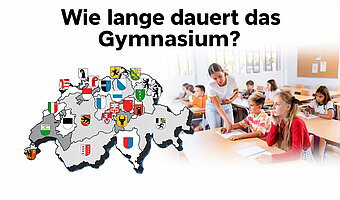
Gymnasium-Dauer: Wie lange dauert Gymnasium in der Schweiz?
Gymnasium-Dauer ist vom Kanton abhängig; wie lange das Gymnasium in der Schweiz dauert, nicht pauschal beantwortbar; hier die Auflistung nach Kantonen.
Schulsystem Aargau - einfach erklärt
Schulsystem Aargau (Bildungssystem Aargau) einfach erklärt: Grundstruktur, einzelne Schulstufen, Schultypen, Abschlüsse; Kindergarten bis Tertiärstufe.
Multicheck Gateway als Vorprüfung zur IMS
Für Zulassung zur IMS-Prüfung akzeptiert Kanton Zürich nur einen einzigen Eignungstest, nämlich den Multicheck vom privaten Anbieter Gateway; wie kann das sein?

Für beste Gymivorbereitung ist Geld nicht ausschlaggebend
Für beste Gymivorbereitung im Kanton Zürich ist nicht Geld ausschlaggebend, sondern Vielzahl von Faktoren, darunter Erziehung, Motivation, Struktur, Leistung.
Abschaffung Gymiprüfung: Kantonsrat Zürich lehnt Vorstoss ab
Abschaffung Gymiprüfung im Kanton Zürich immer wieder diskutiert; im März 2026 lehnte Kantonsrat Zürich einen Vorstoss Richtung Abschaffen der Gymiprüfung ab.
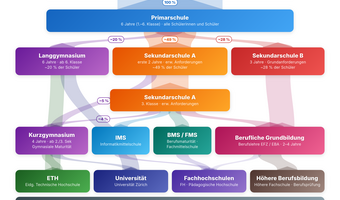
Schulsystem Zürich - einfach erklärt
Hier wird das Schulsystem Zürich einfach erklärt: Grundstruktur, einzelne Schulstufen, Schultypen und Abschlüsse, von der Frühförderung bis zur Quartärstufe.

Eignungstest Lehre: Welche Tests gibt es?
Eignungstest Lehre: Man unterscheidet berufsneutrale Tests, Eignungstests für bestimmte Berufsfelder, für bestimmte Berufe/ Lehren und betriebsinterne Tests.
