

Vocational Maturity School BMS as alternative to Gymnasium
The vocational maturity school (BMS) is an alternative to the gymnasium, because with the BMS diploma, the vocational maturity (BM), you can also study at university, provided you pass the additional Passerelle exam. The advantage is that you can combine work and study through the BMS route. Even wrong decisions can be corrected by attending a BMS if the apprenticeship was not the right choice after all.
In the following article, we explain what the vocational maturity school is and what the different models are, how long the vocational maturity lasts, what you can do after the BMS, what the history behind the BMS is and why it is a good alternative to the gymnasium for certain students.
And finally, we list the vocational maturity schools in the canton of Zurich.
Best prepare for the BMS entrance exam with a preparatory course!
Table of contents
- What is the BMS and which models are there?
- How long does the vocational Matura take?
- What can you do after the BMS?
- History of the BMS
- BMS is a good alternative to the Gymnasium
- Which vocational maturity schools are there in the canton of Zurich?
What is the BMS and which models are there?
The BMS, which stands for the vocational maturity school, formerly also called the vocational secondary school, is a secondary school that combines vocational training during or after an apprenticeship with an advanced general education. The BMS either starts with the apprenticeship after the obligatory schooling or after the apprenticeship.
The following models are distinguished for the vocational maturity school:
- BMS 1 or BM 1: vocational maturity school during the apprenticeship
- BMS 2 or BM 2: vocational maturity school after the apprenticeship
- BMS 1 flex or BM 1 flex (only possible for certain apprenticeships): vocational maturity school starts with the apprenticeship, but the BMS instruction is extended to a longer period of time; BM-diploma is obtained after the vocational training diploma
There are five different orientations for the vocational maturity school classes:
- Technology, Architecture, Life Sciences
- Nature, Landscape and Food
- Economy and Services (Type Economy, Type Services)
- Design and Art
- Health and Social Care
Meanwhile, about one in four vocational trainees obtain a diploma from the vocational maturity school, of which about half go on to a university of applied sciences. Fewer than 1 percent go on to a university.
How long does the vocational Matura take?
The question of how long the vocational Matura takes cannot be answered uniformly. The BMS 1 takes as long as the apprenticeship. The BMS 1 flex takes one year longer than the apprenticeship. And the BMS 2 takes one year, but the part-time vocational course as part of the BMS 2 takes between one and two years.
Start your BMS preparation course now!
What can you do after the BMS?
The BMS is completed with the so-called Federal Vocational Baccalaureate (FVB) (also known as professional maturity certificate) and upon successful completion of the exams, one receives the Federal Vocational Baccalaureate certificate. With this certificate, one can begin studying at a university of applied sciences.
To be able to study at a university with the Federal Vocational Baccalaureate, i.e. to begin studying at a Swiss university, a teacher training college (PH) or a Swiss Federal Institute of Technology (ETH) with the same level of qualification as with the gymnasial Matura, one must also prove that one has passed an additional exam, the so-called Passerelle.
History of the BMS
In the 1960s, more and more potential apprentices were going to the gymnasium, the secondary schools, and into office jobs, so it was decided to counteract this by creating the vocational secondary school (BMS). The idea was to encourage talented students and make apprenticeships more attractive to those who wanted to continue their education. The competition between the gymnasium and vocational training for talented young people continues to this day.
The BMS was also intended to give children from lower social classes the opportunity to receive higher education.
The first vocational secondary schools in the canton of Zurich began teaching in October 1970, in Wetzikon, Winterthur, and the city of Zurich.
The creation of the vocational maturity examination (BM) in 1993 made it possible to transfer to a university of applied sciences without having to take an entrance examination. The BM examination could be taken during the basic vocational training. However, it was also possible to take the vocational maturity examination later, i.e. after the basic vocational training (BM 2).
The universities of applied sciences are characterised by their proximity to practice, their focus on application and their ability to prepare students for the job market. This also shows their roots in vocational education and training.
In 2005, the Passerelle supplementary examination was introduced, which allowed students to start studying at a Swiss university, a teacher training college (PH) or the Swiss Federal Institute of Technology (ETH) if they passed the examination.
BMS is a good alternative to the Gymnasium
In the past, vocational training was basically a dead end. One could at most still take specialist diplomas and master's exams, but these were not equivalent to a university degree. With the introduction of the Passerelle supplementary examination, the vocational maturity examination became an alternative to the Gymnasium, as it is now possible to start a university or college degree programme if one passes the vocational maturity examination and the Passerelle.
The vocational maturity school is particularly suitable as an alternative for those whose apprenticeship has turned out to be a bad decision, for example because they do not like the professions that are open to them through the apprenticeship or because the pay is too low. Today, this bad decision can be corrected after the apprenticeship by attending the BMS 2. If one then also passes the Passerelle examination, one has the same options at a university, a teacher training college or the ETH as someone with a Gymnasium graduation.
But also students who want to do both, i.e. first an apprenticeship and then go to university or college to study, the BMS is a good alternative, as it allows them to combine work and study in this way.
Students who have used the BMS to gain entry to a university or college via the Passerelle route have already completed an apprenticeship, which gives them an advantage thanks to the BMS route. These students can earn a significantly better income during their studies in their apprenticeship profession as a part-time worker than they would in a normal student job, such as in the gastronomy.
Another way to finance studies is to successfully apply for a scholarship, which is dependent on the parents' income. The rules for scholarships vary from canton to canton.
Which vocational maturity schools are there in the canton of Zurich?
There are public (state-run) and private vocational maturity schools in Switzerland; the canton of Zurich also has both types of BMS. However, training at state-run BMS is free of charge, unlike at private BMS.
To be accepted at a BMS, however, one must meet certain admission requirements, which are structured differently depending on the model - BM 1 or BM 2. As a rule, one must pass an admission exam for the BMS. Under certain conditions, however, one can also transfer to the vocational maturity school without taking the exam.
Please also read our article "Tips for the BMS admission exam 2026 (Zurich vocational maturity school) and FAQs".
In the following list, we list the vocational maturity schools in the canton of Zurich (BMS in Zurich):
- Berufsfachschule für Lernende mit Hör- und Kommunikationsbehinderung
- Berufsfachschule Uster
- Berufsmaturitätsschule Strickhof
- Berufsmaturitätsschule Winterthur
- Berufsmaturitätsschule Zürich
- Berufsschule Bülach
- Bildungszentrum Zürichsee
- UNITED school of sports
- Wirtschaftsschule KV Winterthur
- Wirtschaftsschule KV Zürich
Book a BMS preparation course now!
Sources
- Unterschiedliche Chancen - Bildung vererben: Warum so wenige Lehrlinge später studieren (last accessed: 13.10.2026)
- Tips for BMS entrance exam 2027 (Vocational Maturity School) (last accessed: 13.10.2026)
- BMS Preparation in Zurich – Unlock Your Child’s Full Potential (last accessed: 13.10.2026)
Intensive grammar school prep course: Who it's for
Intensive grammar school prep courses: Intensive grammar school prep courses offered primarily during school breaks; find out which course is right for you.
Reforms at grammar schools in Aargau from 2027/2028
Grammar school reforms in canton Aargau 2027/2028: uniform curriculum, different subjects, sport be relevant for promotion, new examination subjects and more.
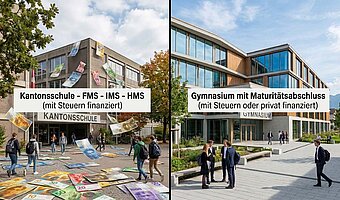
What is the difference between grammar and cantonal school?
In cantons of Zurich and Aargau, a grammar school and a cantonal school are not same thing. Rather, there is a difference between grammar and cantonal school.
Lowest failure rate in probationary period grammar school
Find out here where the failure rate during the probationary period at grammar schools in the Canton of Zurich is lowest, and other selection criteria.
AI increasingly important: Is IMS training up to date?
Here, we explain whether the IMS training at the Zurich Informatics Secondary School is still relevant in light of development of artificial intelligence (AI).
Training quality: Vocational training worse than reputation
The quality of vocational training in Switzerland is heavily criticized; vocational training is worse than its reputation – reports and surveys confirm this.
Rychenberg cantonal school: new arts and sports grammar school
At Rychenberg Cantonal School in Winterthur, a second arts and sports grammar school in the canton of Zurich is set to open in the 2029/2030 academic year.
Switzerland: Early selection in schools - pros and cons
Many cantons in Switzerland are known for the early school selection, often at the age of 12 or 13. Read the arguments for and against here in our article.
Is the Swiss Matura more difficult than the German Abitur?
In this comparison, you'll find the answer whether Swiss Matura or German Abitur is more difficult, and what the difference is between Matura and Abitur.

15 focus subjects at grammar schools 2029/2030 in Zurich
Starting in 2029/2030 school year, 15 focus subjects at grammar schools in Canton Zurich will replace current 13 focus subjects and 6 grammar school profiles.
