

The question of whether the Swiss Matura (Swiss grammar school diploma) is more difficult than the German Abitur (German grammar school diploma) is a particular concern for expats from Germany.
But parents of children living near the border between Germany and Switzerland also repeatedly consider whether it might be tactically smarter to send their child to a grammar school in the neighboring country, because the graduation might be easier there.
In the following article, we compare the Swiss Matura and the German Abitur and explore which of the two grammar school qualifications is more difficult.
Start your grammar school preparation course now!
The most important points in brief:
|
Table of contents
Swiss Matura vs. German Abitur: Differences
Parents in Switzerland who live on the German border, and whose children have completed the German Abitur and the Swiss Matura, say: The Swiss Matura is "clearly more difficult".
Education expert Stefan Wolter’s comments to the Süddeutsche Zeitung regarding the quality of grammar school education also point in the same direction: “The average Swiss grammar school graduate is simply better than the average German grammar school graduate.”
Stefan Wolter also offers a plausible explanation for why grammar school in Switzerland remains more challenging than in Germany to this day. According to him, the 1968 movement played no major role in Switzerland. Unlike in Germany, the 1968 movement’s demand that as many people as possible should have the opportunity to attend university had largely no effect in Switzerland.
Nevertheless, more people in Switzerland aged 25 to 34 hold a tertiary education degree than in Germany. This is due in particular to the fact that in Switzerland, after completing an apprenticeship, one can study at a university of applied sciences by obtaining, for example, an additional vocational baccalaureate. In Switzerland, it is also possible to pursue advanced vocational training after gaining some work experience.
In this context, read our article «Dual education system: high income without university degree».
Other voices - like the one of Birklehof private boarding school and grammar school from Germany - are more differentiated regarding the question of whether the Swiss Matura or the German Abitur is more difficult: "The requirements [of the Swiss Matura and the Abitur] are comparable, but structured differently. An objective statement about the difficulty depends on the individual profile."
Before we can answer the question of whether the Swiss Matura is really more difficult than the German Abitur, we must understand the differences between these two grammar school qualifications.
Challenges in comparing the Swiss Matura and the Abitur
What makes comparing the Swiss Matura and the German Abitur somewhat difficult is that education in both countries is organized on a federal basis. This means that neither Switzerland nor Germany has a uniform grammar school diploma; rather, the Matura and the Abitur differ depending on the canton or federal state.
However, there are certain standardizations among the cantons and federal states in both countries to ensure that the Swiss Matura and the German Abitur are comparable nationwide. We will use these standardizations as the basis for our comparison of the Swiss Matura and the German Abitur below.
In Germany, there is even a kind of centralized Abitur in certain subjects, but generally speaking, the Abitur in Germany varies greatly depending on the federal state in which it is taken. This is because the federal states are permitted to deviate from the centralized Abitur in many respects.
Matura rate vs. Abitur rate
In Switzerland, the average grammar school graduation rate for the years 2022 through 2024 was 23.2 percent. In Germany, the comparable average rate—that is, the percentage of students earning the Abitur (a diploma granting general university entrance qualifications)—for the years 2022 through 2024 was 33.07 percent.
While the higher grammar school graduation rate in Germany suggests that the Abitur is easier than the Swiss Matura, this perspective is too narrow. This is because the grammar school graduation rate in some Swiss cantons is politically controlled. In Zurich, for example, the grammar school graduation rate is kept artificially low by limiting the number of students admitted to grammar school through the grammar school entrance exam.
Read also our article «Grammar school graduation quota - canton controls since 2007».
It's best to start preparing for grammar school early
Grading system and passing grades
Aside from the different grading scales, the passing thresholds for the Swiss Matura and the German Abitur also differ.
In Switzerland, the grading scale ranges from 6 to 1, with 6 being the highest grade and 1 the lowest. In Germany, the scale is exactly the opposite, with 1 being the highest grade and 6 the lowest.
However, the passing grades are set differently. While a 4 is still a passing grade in Germany, in Switzerland you also need a 4 to pass, even though the grading scale starts at 6. In Germany, therefore, you pass on 4 grade levels from 1 to 4, while in Switzerland you pass on only 3 grade levels, namely from 6 to 4.
As for passing thresholds, in Switzerland it is generally required to achieve 60 percent of the points to pass an exam, whereas in Germany, generally only 50 percent of the points are needed. It is therefore significantly more difficult to pass an exam in Switzerland than in Germany.
Preliminary grades and final thesis
In both Switzerland and Germany, the final grade is determined not only by the grades from the grammar school graduation exams (Matura and Abitur exam grades) but also by preliminary grades—specifically, grades in a wide range of subjects from the student’s school years, with the relevant time period varying by country.
In Switzerland, preliminary grades include the grades in the Matura subjects, which consist of core subjects, a focus subject, and a supplementary subject. The grades from the final year of study in which the subject was taught are considered. In addition, the grade for the Matura thesis (final thesis) is also included in the calculation in Switzerland. There is no such final thesis in Germany. However, some federal states require a so-called “Facharbeit” (specialized research paper), which counts as a substitute for an exam in the relevant course during the qualification phase and does not contribute directly to the final grade as a separate grade.
In Germany, the preliminary grades include the grades from the so-called qualification phase—which generally spans two years or four semesters; basic courses are counted once, while advanced courses are counted twice.
The actual Matura and Abitur exams in both countries are generally taken in five subjects, with the required core subjects—German (in German-speaking Switzerland), mathematics, and a foreign language—being essentially identical in both countries.
Dropping and not including subjects
Unlike the Swiss Matura, the German Abitur allows students to drop certain subjects under specific conditions—except for core subjects (German, mathematics, a foreign language, a natural science, and a social science subject such as history).
In addition, the German Abitur allows students to exclude certain subject grades from their final Abitur grade, provided they meet specific requirements.
The German Abitur thus offers significantly more flexibility to exclude grades from subjects in which you are not as strong from the final Abitur grade. The options available in the Swiss Matura are limited to choosing a focus subject and a supplementary subject.
See also our articles:
- “All grammar schools in canton Zurich and grammar school profiles”
- “15 focus subjects at grammar schools 2029/2030 in Zurich”
Conclusion: The Matura is more difficult than the Abitur
In terms of content, there are now only a few differences between the Swiss Matura and the German Abitur in the individual subjects. Preparatory institutes in Switzerland therefore use the same materials in their Swiss Matura preparation courses as those used by German Abitur students to prepare for their exams. This used to be different, when all subjects—including the basic subjects—had to be completed at the advanced level in Switzerland, a requirement that now applies only to the focus subjects. As a result, the Swiss system is now similar in terms of academic level to the German system with its advanced and basic courses.
However, the flexibility in dropping courses and not adding grades in the German Abitur alone makes it considerably easier than the Swiss Matura, where the only choice lies in selecting focus and supplementary subjects.
In addition, the passing threshold of 60% correct answers on exam questions in Switzerland makes the Matura more difficult than the Abitur, where a student passes an exam with 50% correct answers.
The final thesis required for the Swiss Matura also presents an additional challenge that is only partially present in Germany with the Facharbeit; furthermore, the Facharbeit does not directly contribute to the final grade, but only indirectly.
Overall, it must be concluded that the Swiss Matura is more difficult than the German Abitur.
Passed the grammar school entrance exam? Start the grammar school probationary period course now!
Sources
- Gymnasium Preparation Zurich - don’t leave potential to luck (last accessed: 20.7.2026)
- Abitur vs. Matura (last accessed: 20.7.2026)
- In Switzerland, only the best students go to grammar school (last accessed: 20.7.2026)
- "20 percent of grammar school graduates is the right quota" (last accessed: 20.7.2026)
- Dual education system: high income without university degree (last accessed: 20.7.2026)
- Swiss grammar school diploma and why the German Abitur at the Birklehof boarding school is an attractive alternative (last accessed: 20.7.2026)
- Education system in Germany: The Abitur (university entrance qualification) should become more comparable (last accessed: 20.7.2026)
- Matura rates by gender, nationality and place of birth, Three-year averages (last accessed: 20.7.2026)
- Graduates and leavers (last accessed: 20.7.2026)
- Grammar school graduation quota - canton controls since 2007 (last accessed: 20.7.2026)
- Preparation for grammar school 4th grade – helping children reach their full potential (last accessed: 20.7.2026)
- Abitur vs. Matura (last accessed: 20.7.2026)
- Gymnasium (last accessed: 20.7.2026)
- All grammar schools in canton Zurich and grammar school profiles (last accessed: 20.7.2026)
- 15 focus subjects at grammar schools 2029/2030 in Zurich (last accessed: 20.7.2026)
- Probationary period courses for Gymnasium | BMS | IMS | HMS | FMS (last accessed: 20.7.2026)
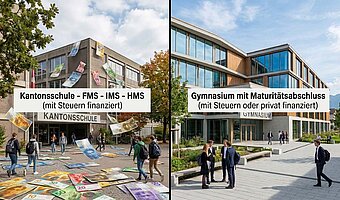
What is the difference between grammar and cantonal school?
In cantons of Zurich and Aargau, a grammar school and a cantonal school are not same thing. Rather, there is a difference between grammar and cantonal school.
Lowest failure rate in probationary period grammar school
Find out here where the failure rate during the probationary period at grammar schools in the Canton of Zurich is lowest, and other selection criteria.

AI increasingly important: Is IMS training up to date?
Here, we explain whether the IMS training at the Zurich Informatics Secondary School is still relevant in light of development of artificial intelligence (AI).
Training quality: Vocational training worse than reputation
The quality of vocational training in Switzerland is heavily criticized; vocational training is worse than its reputation – reports and surveys confirm this.
Rychenberg cantonal school: new arts and sports grammar school
At Rychenberg Cantonal School in Winterthur, a second arts and sports grammar school in the canton of Zurich is set to open in the 2029/2030 academic year.
Switzerland: Early selection in schools - pros and cons
Many cantons in Switzerland are known for the early school selection, often at the age of 12 or 13. Read the arguments for and against here in our article.
15 focus subjects at grammar schools 2029/2030 in Zurich
Starting in 2029/2030 school year, 15 focus subjects at grammar schools in Canton Zurich will replace current 13 focus subjects and 6 grammar school profiles.
New grammar school in Zurich: «Kantonsschule Aussersihl»
With Hohlstrasse branch becoming independent as ‘Kantonsschule Aussersihl’ (KAS), Zurich-West gaining new grammar school and a new secondary technical school.
Grammar school graduation quota - canton controls since 2007
Grammar school graduation quota in Canton Zurich is managed by the Department of Education, specifically through the pass rate, various control mechanisms.
Preparatory institutes alarmed: Sec school pupils know nothing
Exam preparation institutes such as Lern-Forum sounding alarm: Secondary school students have significant gaps in knowledge of math and in French vocabulary.
