


In the media and in response to enquiries from the Cantonal Council, the Department of Education of the Canton of Zurich has repeatedly suggested in recent years that there is no controlled grammar school graduation quota in the canton.
In fact, however, the grammar school graduation quota in the Canton of Zurich has been indirectly controlled via the pass rate (‘passes per cohort’) of the grammar school entrance exam since 2007, and this remains the case to this day (2026). In 2009, the Department of Education even publicly acknowledged that it controls the pass rate for the grammar school entrance examination; in response to an enquiry from the Lern-Forum, the Department of Education now at least confirms the control mechanisms.
Incidentally, there was already a consensus in the canton of Zurich in the 2000s that a grammar school graduation rate of 20 per cent would be ideal. In both 2023 and 2024, the grammar school graduation rate in the canton of Zurich remained constant at 20.3 per cent, meaning that the ideal has now been achieved.
Start your grammar school preparation course now!
The most important points in brief:
|
Table of contents
- Have the graduation rates and pass rates for grammar schools been set?
- Control mechanisms for the grammar school quotas in the Canton of Zurich
- Conclusion
Have the graduation rates and pass rates for grammar schools been set?
In the media, the Zurich Cantonal Education Department regularly denies that there is a set pass rate for the grammar school entrance exam. For example, Niklaus Schatzmann, Head of the Secondary and Vocational Education Office at the Zurich Cantonal Education Department, told the NZZ in 2025 that the Canton of Zurich does not set a pass rate prior to the grammar school entrance exam. Rather, he claimed, the trick lay in the examination board’s experts devising exam questions of roughly the same level of difficulty each year.
However, the allegedly consistent level of difficulty in the exam questions contradicts the annually changing marking schemes, which are available to the Lern-Forum for the years 2022 to 2025 for both the long-term grammar school exam and the short-term grammar school exam. If the exam questions were indeed of the same difficulty every year, there would be no need to change the marking schemes. Yet these changes do occur.
For instance, in 2025, 29 points were required in the German language exam for the long-term grammar school to achieve a mark of 4.75, whereas in 2024, between 28 and 29 points were needed for the same mark. In the mathematics exam for the long-term grammar school in 2025, only 24 points were needed for a grade of 4.75, whereas in 2024, 27 points were still required for the same grade.
Long-term grammar school exam | German language test | Mathematics exam |
2022 | 36 points = grade 4.75 | 27-28 points = grade 4.75 |
2023 | 32-33 points = grade 4.75 | 22 points = grade 4.75 |
2024 | 28-29 points = grade 4.75 | 27 points = grade 4.75 |
2025 | 29 points = grade 4.75 | 24 points = grade 4.75 |
Source: Secondary and Vocational Education Office of the Education Directorate of the Canton of Zurich
The grading scale for the short-term grammar school exam is also subject to annual changes. In 2025, a score of between 49 and 51 points was required in the German language exam for the short-term grammar school to achieve a grade of 4.75. In 2024, a score of between 46 and 47 points was required for a 4.75. In the mathematics exam for the short-term grammar school, in 2025 you needed between 25 and 26 points for a grade of 4.75, whereas in 2024, 22 points were sufficient.
Short-term grammar school exam | German language test | Mathematics exam |
2022 | 49-50 points = grade 4.75 | 24 points = grade 4.75 |
2023 | 55-56 points = grade 4.75 | 24-25 points = grade 4.75 |
2024 | 46-47 points = grade 4.75 | 22 points = grade 4.75 |
2025 | 49-51 points = grade 4.75 | 25-26 points = grade 4.75 |
Source: Secondary and Vocational Education Office of the Education Directorate of the Canton of Zurich
In 2022, Niklaus Schatzmann told the NZZ regarding the strikingly consistent pass rate for the long-term grammar school exam over the years, which stood at plus or minus 15 per cent (‘Pass rate/cohort’):
‘The 15 per cent is not a predetermined target, but rather a retrospective confirmation that the grammar school exam was neither too difficult nor too easy.’
In 2023, two members of the Zurich Cantonal Council accused the Department of Education of the grammar school examination not being objective, because the provisional marking schemes were still being altered after correction, meaning they were only finalised after the grammar school examinations had been corrected. The grammar school entrance exam was therefore relative, they argued, because it was only after the exam had been taken that a decision was made as to which results would allow pupils to progress to grammar school. In response, the Department of Education of the Canton of Zurich replied via the cantonal government that a slight retrospective adjustment to the marking scheme could, for example, be made if candidates had performed worse than expected on a particular question.
The response does not state whether this would also apply in the reverse scenario, even though finding this out was a key focus of the enquiry. It was only in response to a query from the Lern-Forum that the Department of Education admitted that the grading scale would also be adjusted downwards retrospectively if, contrary to expectations, candidates performed better.
In response to a further enquiry from the Lern-Forum to the Office for Secondary and Vocational Education of the Canton of Zurich as to whether there was a fixed grammar school graduation quota in the canton, the Office stated in early June 2026 that both the grammar school graduation rate and the pass rate (‘Passed/Taken’) for the grammar school entrance exam varied from year to year, meaning that neither figure was fixed. But how accurate is this claim?
Grammar school graduation quota controlled despite increase
With regard to the grammar school graduation quota, the Office for Secondary Education and Vocational Training refers to the canton’s statistics, which show the following trend in the grammar school graduation quota in the Canton of Zurich since 2014:
In fact, statistics on the grammar school graduation rate in the canton of Zurich show that it has continued to rise slightly in recent years. In 2009, it stood at 17.3%, although data collection methods were different at that time, making a direct comparison with the data from 2014 onwards difficult.
Nevertheless, the reference by the Office for Secondary Education and Vocational Training to the change in the grammar school graduation rate since 2014 does not invalidate the observation that the Canton of Zurich controls the grammar school graduation rate by regulating the pass rate for the central entrance examination (grammar school exam). This is because the rise in the grammar school graduation rate since 2014 can be explained by the higher retention rate following the grammar school probationary period and does not result from a supposedly uncontrolled entrance examination.
In the 2015/2016 school year, the retention rate following the grammar school probationary period at the long-term grammar school was still 83 per cent. In 2017/2018, the retention rate had already reached 89.1%. The retention rate for the probationary period also rose at the short-term grammar school, from 77.8% in 2015/2016 to 82% in the 2017/2018 school year.
By the 2025/2026 school year, the retention rate following the grammar school probationary period had reached 92.9 per cent at the long-term grammar school and 90.2 per cent at the short-term grammar school.
Book a preparation course for the grammar school trial period now
Pass rate of long-term grammar school exam almost constant since 2007
As for the claim made by the Canton of Zurich to the Lern-Forum that the pass rate (proportion of exams passed out of the total number of candidates) has not been set because it varies from year to year, this is not convincing. If, for example, one looks at the pass rate for the long-term grammar school examination over the last four years, the variations are minimal: 2022/2023: 52.7%, 2023/2024: 53.2%, 2024/2025: 53.6%, 2025/2026: 52.7%. If we consider the long-term grammar school exam pass rate as the proportion of exams passed relative to all Year 6 pupils, this pass rate is even more constant.
Since the entrance examinations for grammar schools in the Canton of Zurich were centralised in 2007 and organised by the Zurich Department of Education, the pass rate for the long-term grammar school examination, relative to all pupils in the year group, has remained constant at around 15%, with slight fluctuations up and down (see statistics for the years 2000–2014 and statistics for the years 2011–2024). In the 2025/2026 school year, it was 15.1%, in the 2024/2025 school year: 14.9%, in the 2023/2024 school year: 14.8% and in the 2022/2023 academic year: 15.3%.
Although the figures were incorrectly calculated by the Department of Education in the meantime, this amounted to less than half a percentage point on average in the long-term grammar school examination, which is why this error can be disregarded here.
Pass rates for short-term grammar school exams also remain almost constant
At most, the Canton of Zurich’s claim that the pass rate (the proportion of candidates who pass the exam) is not fixed because it varies from year to year might hold water in the case of the short-term grammar school exam. For the short-term grammar school examination in the 2nd year of secondary school, the figures were: 2022/2023: 43.1%, 2023/2024: 39.3%, 2024/2025: 38%, 2025/2026: 40.2%. For the short-term grammar school exam in the third year of secondary school, the figures were: 2022/2023: 50.8%, 2023/2024: 44.2%, 2024/2025: 45.2%, 2025/2026: 47%.
However, if one looks at the statistics on the pass rate since 2022/2023 in relation to the total number of pupils in the year group, this rate remains constant at around 7.5% for those transferring to the short-term grammar school after the second year of secondary school, with only slight fluctuations up and down. And when transferring to the short-term grammar school after the third year of secondary school, it remains constant at around 6%, with only slight fluctuations up and down. In this respect, the Education Department’s objection that the pass rate (‘Passed/Examined’) is not fixed because it changes from year to year is not convincing here either, as the pass rate (‘Passed/Cohort’) hardly changes at all:
There were also calculation errors made by the Department of Education regarding the pass rates for the short-term grammar school examinations in the years up to 2020; however, these errors were more significant, which is why we must make do with the data provided by the Department of Education from the 2022/2023 school year onwards.
In the next section, we will examine how the Canton of Zurich achieves these almost constant pass rates (‘Passed/Cohort’) and why we must refer to these as controlled rates.
Control mechanisms for the grammar school quotas in the Canton of Zurich
Back in 2009, the Department of Education of the Canton of Zurich explained how it controls the pass rate for the entrance examination – and thus the grammar school graduation quota in the canton – to ensure that this proportion remains at its current level.
The average grade for the German essay is dictated in advance
Firstly, there is an internal directive from the Department of Education instructing correctors that the average mark for the German essay must be between 3.3 and 3.8 per school, as Hans Keller from the Department of Education of the Canton of Zurich told the ‘NZZ am Sonntag’ in 2009 (NZZ am Sonntag, 31 May 2009, p. 12: ‘Zurich grammar schools have to hand out bad grades’ («Zürcher Gymnasien müssen schlechte Noten verteilen»)).
The grammar school entrance exam was therefore marked so harshly to compensate for the overly lenient marking by primary school teachers, Hans Keller from the Department of Education explained to the ‘NZZ am Sonntag’ at the time. If the average mark were not brought down, everyone would pass and the grammar school entrance exam would then be unnecessary.
The Lern-Forum asked the Department of Education whether the average mark for the German essay would still be set in 2026, and the Department of Education replied as follows:
“The internal directive for a uniform average mark in the examination subject ‘German – Writing a Text’ remains in place and has proven its worth in assessment practice.”
According to an article published in 2024 by Philippe Wampfler, a German teacher at Uetikon Cantonal School who is himself involved in correcting the grammar school entrance exams, the range of the prescribed average mark varies from year to year, but is clearly below the average mark required for admission to grammar school.
Downgrading also occurred in the German language and mathematics tasks
However, the German language and mathematics tasks would also be designed in such a way that the average mark remained below 4, as Hans Keller from the Zurich Cantonal Education Department also told the ‘NZZ am Sonntag’ in 2009 (NZZ am Sonntag, 31 May 2009, p. 12: ‘Zurich grammar schools have to hand out bad grades’).
When the Lern-Forum asked the Zurich Cantonal Education Department whether this practice would continue, the department replied:
‘The pass criteria for the ZAP were adjusted with the introduction of the new transfer procedure. However, this does not mean that the difficulty level of the exam questions will be increased. The standard of the exam questions remains the same.
The revised pass mark means that the exam mark is higher, or rather deviates less significantly from the pre-exam mark. In the past, the fact that the exam mark was lower than the pre-exam mark repeatedly caused confusion among pupils and their parents or guardians. By adjusting the pass mark and taking the previous performance mark into account, the ZAP results should become more transparent for pupils and their parents.’
In other words: in substance, nothing has changed here since 2007. Although better marks have been awarded in the grammar school entrance exam since the 2022/2023 academic year, the level of difficulty of the exam questions has remained the same. The status quo regarding selection based on the difficulty of the exam questions, whilst simultaneously awarding higher marks, has been maintained by the fact that candidates must now achieve a higher overall mark to pass the grammar school entrance exam.
Read also our article ‘Preparation for gymnasium exam necessary for passing’.
Conclusion
The grammar school entrance exam remains a major hurdle for pupils transferring to grammar school in the canton of Zurich. Private preparatory institutes have been helping candidates overcome this hurdle for decades now. In recent years, state schools in the canton of Zurich have also increasingly been offering grammar school preparation courses and are continually expanding this program.
However, it is questionable whether Zurich pupils are in good hands in the grammar school preparation courses offered by the cantonal school system, given that it is precisely this system that does not want all pupils to pass the grammar school entrance exam, as Hans Keller, project manager for the central entrance exams at the Zurich Cantonal Education Department, stated quite openly to the NZZ am Sonntag in 2009 (NZZ am Sonntag, 31 May 2009, p. 12: ‘Zurich grammar schools have to hand out bad grades’).
The fact that the Zurich Office for Secondary and Vocational Education is not countering the rise in the grammar school graduation rate in the Canton of Zurich by lowering the pass rate for the entrance examination can be explained by the fact that the current figure of 20.3 per cent corresponds to the consensus on how many pupils in a year group should attend grammar school.
This consensus on the so-called ‘talent pool’ has existed in the canton of Zurich since at least the 2000s, with the view that a 20% grammar school graduation rate is ideal, as Felix Angst, headteacher of the Zürcher Unterland Cantonal School, told the NZZ in 2009. However, should the grammar school graduation rate rise significantly above 21%, it is to be expected that the Department of Education will take countermeasures and further tighten the entrance examination in order to keep the transfer rate to grammar school down.
It is misleading that Niklaus Schatzmann, Head of the Secondary School and Vocational Training Office at the Zurich Cantonal Department of Education, continues to act as though the grammar school graduation rate is not being controlled, when he claims that the 15 per cent pass rate among all Year 6 pupils in the long-term grammar school entrance exam is not a set target. It may well be that a precise target of 15.00 per cent is not being aimed for. But it has been known since at least 2009 that the Department of Education of the Canton of Zurich wishes to keep the transition rate to the long-term grammar school within the range it was and is today, and it is precisely this target that the Department of Education has achieved over the last few decades through targeted control mechanisms. There is simply no other way to explain the almost constant pass rates for the long-term grammar school examination across the entire cohort. The main aim was to break the trend whereby an increasing number of grammar school pupils were starting at the long-term grammar school, which would have lowered the standard of secondary school due to a lack of high-achieving pupils, as reported in the NZZ am Sonntag in 2009.
The consistency in pass rates is not, in fact, due to the fact that experience allows us to know exactly in advance which tasks to set in order to always find the most suitable candidates for grammar school – candidates who supposedly always correspond to the ‘magic’ 15 per cent for the long-term grammar school or the 6–7.5 per cent for the short-term grammar school. No, the consistency in pass rates is explained by the fact that the average mark for the essay is set in advance, whilst the marking scales for the German language and mathematics tasks are adjusted retrospectively depending on the candidates’ performance.
The Department of Education has also been misleading the Cantonal Council regarding the retrospective adjustment of marking scales for the German language and mathematics tasks. In response to a question from two members of the Cantonal Council, education officials stated that the marking scale would be adjusted upwards retrospectively if candidates performed worse than expected. The possibility of the opposite scenario was simply omitted from the reply. It was only following an enquiry from the Lern-Forum that the Department of Education admitted that the marking scheme would also be adjusted downwards retrospectively if the candidates performed better than expected.
However, the pass rate for the entire cohort in the short-term grammar school examination also shows a striking consistency, albeit with slightly greater fluctuations than the rate for the long-term grammar school examination. The almost constant short-term grammar school rate can also only be explained by control exerted by the Department of Education.
By controlling the pass rates for the long- and short-term grammar school examinations, the Department of Education has also been indirectly controlling the grammar school graduation rate in the Canton of Zurich since 2007.
Sources
- Gymnasium Preparation Zurich - don’t leave potential to luck (last accessed: June 9, 2026)
- Gymnasium entrance exam in the canton of Zurich: There have never been as many candidates as this year – one region is performing much better than all the others (last accessed: June 9, 2026)
- Grammar school entrance exams in Zurich: Is the quota more important than the students' performance? (last accessed: June 9, 2026)
- Inquiry from the Cantonal Council to the Directorate of Education RR 120/2023: Central entrance examination for grammar school (last accessed: June 9, 2026)
- Grammar school graduation rate (last accessed: June 9, 2026)
- How many grammar school graduates does Switzerland need? (last accessed: June 9, 2026)
- Admission to grammar school: retention during the probationary period in long- and short-term grammar schools in the canton of Zurich (last accessed: June 9, 2026)
- Results of 2026 grammar school exam in the Canton of Zurich (last accessed: June 9, 2026)
- Probationary period courses for Gymnasium | BMS | IMS | HMS | FMS (last accessed: June 9, 2026)
- Where grammar school is compulsory (last accessed: June 9, 2026)
- Grammar school entrance exam: how many passed this year, where they come from – and why fewer and fewer are failing the probationary period (last accessed: June 9, 2026)
- Statistics on the central entrance examination (last accessed: June 9, 2026)
- The success rate of the grammar school entrance exams has been calculated incorrectly for years (last accessed: June 9, 2026)
- The puzzle of the scales in the entrance exam in the canton of Zurich (last accessed: June 9, 2026)
- Preparation for gymnasium exam necessary for passing (last accessed: June 9, 2026)
- Sharp criticism of the grammar school entrance exam (last accessed: June 9, 2026)
- Grammar school preparation 1st Sec. – Secure Opportunities for Your Child Early On (last accessed: June 9, 2026)

Intensive grammar school prep course: Who it's for
Intensive grammar school prep courses: Intensive grammar school prep courses offered primarily during school breaks; find out which course is right for you.
Reforms at grammar schools in Aargau from 2027/2028
Grammar school reforms in canton Aargau 2027/2028: uniform curriculum, different subjects, sport be relevant for promotion, new examination subjects and more.
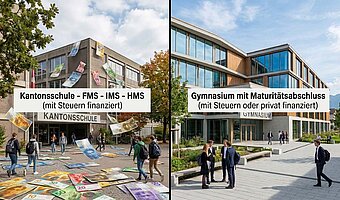
What is the difference between grammar and cantonal school?
In cantons of Zurich and Aargau, a grammar school and a cantonal school are not same thing. Rather, there is a difference between grammar and cantonal school.
Lowest failure rate in probationary period grammar school
Find out here where the failure rate during the probationary period at grammar schools in the Canton of Zurich is lowest, and other selection criteria.

AI increasingly important: Is IMS training up to date?
Here, we explain whether the IMS training at the Zurich Informatics Secondary School is still relevant in light of development of artificial intelligence (AI).

Training quality: Vocational training worse than reputation
The quality of vocational training in Switzerland is heavily criticized; vocational training is worse than its reputation – reports and surveys confirm this.
Rychenberg cantonal school: new arts and sports grammar school
At Rychenberg Cantonal School in Winterthur, a second arts and sports grammar school in the canton of Zurich is set to open in the 2029/2030 academic year.
Switzerland: Early selection in schools - pros and cons
Many cantons in Switzerland are known for the early school selection, often at the age of 12 or 13. Read the arguments for and against here in our article.
Is the Swiss Matura more difficult than the German Abitur?
In this comparison, you'll find the answer whether Swiss Matura or German Abitur is more difficult, and what the difference is between Matura and Abitur.

15 focus subjects at grammar schools 2029/2030 in Zurich
Starting in 2029/2030 school year, 15 focus subjects at grammar schools in Canton Zurich will replace current 13 focus subjects and 6 grammar school profiles.
