



For best preparation for grammar school money isn’t decisive
If you want the best preparation for your child’s entry to grammar school, money alone won’t buy it.
Grammar school preparation courses are certainly important, and private providers charge a fee for them. However, there are many other factors that contribute to successful preparation, which we outline in the following article.
It’s best to start preparing for grammar school early!
Table of contents
- Media criticism of fee-based preparatory courses
- 6 factors for the best preparation for grammar school
- Conclusion
Media criticism of fee-based preparatory courses
On 2 March 2026, the annual grammar school entrance exam took place in the canton of Zurich. Before and after the exam, the media was full of reports claiming that children from wealthy families had the best chances of passing, as supposedly only affluent families could afford grammar school preparation courses.
This criticism of private grammar school preparation courses, which were said to give children from wealthy families an unfair advantage, was first voiced in the NZZ am Sonntag back in 2009 and has been repeated time and time again to this day.
For example, in an interview with an education expert in the Tagesanzeiger this year, i.e. 2026, the choice of headline and summary gave readers the impression that money was the all-important factor in grammar school preparation.
This went so far that, in this Tagesanzeiger interview, reference was made to the 2018 Education Report to suggest that low-performing pupils from upper-class backgrounds only managed to gain entry to grammar school thanks to the help of allegedly expensive preparatory courses, thereby taking places away from high-performing pupils from lower-class backgrounds, as the latter supposedly could not afford such courses. However, the 2018 Education Report explicitly distances itself from such a causal link.
You may also be interested in the following article: ‘Equal or unequal opportunities in education?’
6 factors for the best preparation for grammar school
Apart from the fact that there are also affordable options for preparing for the central grammar school entrance exam (ZAP) through private grammar school preparation courses, and that many state schools now even offer free grammar school preparation courses, money is not the deciding factor when it comes to the best preparation for grammar school – for other reasons too; as even critics of fee-based grammar school preparation courses themselves admit.
In fact, there are a multitude of other factors that are decisive for the best grammar school preparation. Thanks to our many years of experience at the grammar school preparation institute Lern-Forum, we know what is important when it comes to grammar school preparation. We would like to highlight six key factors for grammar school preparation in particular.
1. Educational methods
One factor that influences a child’s academic performance is the educational style of their parents. For example, it is well known that parents from the upper and middle classes place stricter limits on their children’s media consumption than parents from the lower classes. As a result, children from the upper and middle classes have more time to focus on schoolwork and exam preparation.
In families affected by poverty, it is generally observed that the parenting style is characterised by inconsistency and spoiling. Inconsistency is explained, amongst other things, by the parents’ personal stress, whilst spoiling is attributed, amongst other factors, to the parents’ own deprivations during their childhood and adolescence. However, preparing for the grammar school entrance exam requires the opposite of inconsistency and indulgence: namely, motivation, structure, order, perseverance and consistency.
Once parents from the lower classes become aware of this pattern, they can adapt their behaviour to that of the middle and upper classes, replacing inconsistency and spoiling with the promotion of motivation, structure, order, perseverance and consistency.
There are also differences in parents’ controlling behaviour depending on social class. Parents with higher levels of education tend to be more accepting and egalitarian towards their children, whilst parents from lower social classes tend to behave in a more authoritarian manner. When children are allowed to argue with their parents rationally and without fear about why they believe the boundaries of their autonomy have been overstepped, this fosters the development of their own judgement and encourages decisiveness. This is not possible in an authoritarian upbringing, which is why parents from the lower classes should adapt their parenting style.
2. Motivation and frustration tolerance
When it comes to motivation for learning, the key is to foster the child’s intrinsic motivation – that is, the drive that comes from within the child themselves, through an interest in or enjoyment of learning. External motivation through pressure or fear is nowhere near as effective or lasting as intrinsic motivation. This is because perseverance is also crucial when preparing for grammar school, a process that ideally spans several years. And later on at grammar school, there are further challenging years to overcome in order to eventually obtain the grammar school leaving certificate.
Parents can foster their children’s intrinsic motivation in particular by helping them to develop frustration tolerance. Frustration tolerance refers to the ability to cope with a frustrating situation, such as a poor mark in an exam or not understanding the schoolwork.
Specifically, parents can encourage their child to keep going if they’ve failed an exam or don’t grasp the material straight away, for example by saying: ‘Don’t let it get you down, it’ll be alright.’ They should also make it clear to the child that making mistakes is part of learning, for instance by saying: ‘You learn from your mistakes. Everyone makes mistakes sometimes, because to err is human.’
By showing that they believe in their child, even when things don’t go to plan straight away, parents also boost their children’s self-confidence. If a test goes badly, for example, you can highlight individual successes in the learning process, perhaps by saying: ‘You studied with great concentration. Maybe you were just unlucky in the test. You’ll definitely have better luck next time!’
And you should also regularly let the child know that you love them regardless of their academic performance, for example by saying: ‘I love you even if you don't make it to grammar school.’
So the factor of parental motivation for grammar school is not a financial one either.
3. Structured daily routine and orderly household
To organise yourself effectively, you need a structured daily routine. That is why children should always get up on time, have breakfast, then go to school, take a lunch break and carefully do their homework after school. Those who attend an all-day school often do their homework there.
In the evening, all family members should have dinner together at a set time. Such family routines strengthen organisation at home and family cohesion. After dinner, the children should then prepare for the next day, in particular by packing their school bags.
Domestic order is also important: it should always be clean and tidy. The home should feel welcoming and cosy.
4. Help with schoolwork
Another important factor in preparing for the grammar school entrance exam is help with schoolwork. This help doesn’t always have to come from parents. Siblings, in particular, can also help explain the schoolwork. This is especially effective if an older sibling has made it into grammar school and can help all their younger siblings pass the entrance exam as well.
Furthermore, there are now many explanations available online, most of which are free of charge. The argument that there are more books in an academic household than in a non-academic one, and that children of academics therefore have an advantage, is therefore no longer convincing today.
5. Interest in the child and support
Showing an interest in your own child is also a key factor in their academic progress. You can show this interest, for example, by telling your child: ‘You’re important to me!’ or ‘Your hobbies are great!’ or ‘Your plans for the future sound exciting!’.
When your child wants to tell you something, you should take the time to listen with curiosity and ask questions. In this way, you show your child that you are there for them. If your child knows they can turn to you, they will continue to do so in the future, for example to seek advice. You will also be taken more seriously by your children if you are familiar with teenage issues.
Spending time with your child also shows interest. Shared educational experiences are a good way to demonstrate that parents and children are interested in learning together – in other words, that you’re on the same page. You can create such shared experiences through educational excursions during the holidays or at weekends, such as visits to museums or historical sites, or perhaps by going for walks in the countryside.
An educational excursion or even an educational trip not only strengthens family bonds, but also helps to make theoretical knowledge more tangible and lasting through hands-on learning. Educational trips also encourage curiosity and, with it, the motivation to learn new things.
Playing together is another way to spend time with your child. For children, play is important for getting to know the world, discovering their own creativity, practising problem-solving, regulating emotions and protecting themselves from stress. Parents can use their own hobbies, such as painting, playing football or skiing, to play with their child by letting them join in.
Furthermore, parents should provide emotional support for their child as they prepare for grammar school, showing empathy, compassion and understanding towards their child during this difficult period of preparation. The child must feel that their parents understand the difficult challenge they face with the grammar school entrance exam. Emotional support can be shown, for example, by praising the child for taking on the exam. Parents could say, for instance: ‘We’re proud that you’re trying the grammar school entrance exam.’ A warm hug can reinforce this even further.
Furthermore, parents should support their child with additional measures during the exam period. In the months leading up to and during the exams, for example, parents should avoid causing the child any additional stress by, amongst other things, relieving them of household and gardening chores. A quiet study environment should also be created. Furthermore, parents should ensure that the child takes sufficient breaks from studying, for example by going for walks, playing sport or making music, as physical activity helps the child to process what they have learnt more effectively. Parents should also ensure a balanced diet.
Here you will find further ‘Tips for parents to support the child during the exam phase’.
When talking to parents, teachers can sense whether they are willing to make time to support their child in achieving the grammar school Matura. If teachers feel that parents will not provide sufficient support for their children to gain entry to the grammar school and to pass the Matura there, many teachers tend not to recommend children of such parents for transfer to the grammar school.
6. Consistent performance
Another key factor in preparing effectively for the grammar school entrance exam is maintaining consistent performance. This is because, on the one hand, previous grades from primary and secondary school are also taken into account in the entrance exam. It is therefore important to achieve good results even before the exam.
Secondly, you have a better chance of receiving support from teachers if you demonstrate to them early on that you are capable of consistently achieving good results.
It is advisable to start preparing for the grammar school entrance exam as early as Year 4 of primary school, so that you are counted among the group of high-achieving pupils from the outset. It is essential to avoid being labelled a weak pupil, as it is difficult to shake off that label. Exam preparation centres such as the Lern-Forum in Zurich offer special preparatory courses for pupils in the 4th and 5th years of primary school who wish to attend grammar school later on, so that these pupils can achieve success at school from an early age.
Grammar school preparation courses from Year 4
Grammar school preparation courses from Year 5
Conclusion
Money is therefore no guarantee that you will pass the grammar school entrance exam and thus gain a place at a state grammar school. For the best possible preparation for the grammar school entrance exam, a whole range of factors must be in place, including the right educational methods, motivation, frustration tolerance, a structured daily routine, a tidy home, help with schoolwork, parental interest in the child, emotional support and consistent performance – ideally starting from Year 4 of primary school or even earlier.
Where money does play a decisive role is when transferring to a private grammar school, where school fees of up to CHF 30,000 per year are sometimes charged, which is why wealthy families have a clear advantage here. Although private grammar schools generally have specific admission requirements, pupils do not need to have passed the central entrance exam set by the Canton of Zurich to be allowed to transfer to a private grammar school.
One should also question the observation made by the Handelszeitung in this year’s article ‘Rush for expensive preparatory courses. Lucrative business with grammar school entrance exams’, in which the newspaper concludes that there is high demand for these courses based on the fact that there are many private grammar school preparation courses on offer, with new ones appearing all the time. One could, in fact, draw the opposite conclusion: that the number of providers of grammar school preparation courses is increasing year on year precisely because many media outlets tout these courses as a ‘lucrative business’ every time grammar school entrance exams take place, thereby attracting a constant stream of opportunists who set up new grammar school preparation institutes.
Moreover, it does not reflect reality to portray academic parents as uniformly privileged and well-off, and non-academic parents as uniformly disadvantaged and poor, in the debate over the affordability of private grammar school preparation courses. After all, there are also many non-academics who earn a good wage, for example following an apprenticeship. Furthermore, even as a non-graduate, one can progress in one’s career and, as a senior manager, director or even an entrepreneur, earn significantly more than a graduate.
Alternative to grammar school: Enrol in a BMS preparation course now!
You may also be interested in the following articles:
- «Educational advancement: Can social advancement be planned through education?»
- «High income without a university degree thanks to the dual education system»
Sources
- Preparation for grammar school 4th grade – helping children reach their full potential (last accessed: 28.3.2026)
- Sharp criticism of the grammar school entrance exam (last accessed: 28.3.2026)
- Expensive preparatory courses: ‘This is how the grammar school diploma becomes a matter of money’ (last accessed: 28.3.2026)
- Education Report Switzerland 2018 (last accessed: 28.3.2026)
- Equal or unequal opportunities in education? (last accessed: 28.3.2026)
- Gymnasium Preparation Zurich - don’t leave potential to luck (last accessed: 28.3.2026)
- The impact of class differences on upbringing (last accessed: 28.3.2026)
- Educational success: 4 factors for success (last accessed: 28.3.2026)
- Educational trips with family (last accessed: 28.3.2026)
- Tips for parents to support the child during the exam phase (last accessed: 28.3.2026)
- Grade Calculator for Grammar School Exam (last accessed: 28.3.2026)
- Grammar School Preparation 5th Grade - Developing the Child's Potential Early On (last accessed: 28.3.2026)
- Private schools in Switzerland: Is there really a private school boom? (last accessed: 28.3.2026)
- Information about FSZ tuition fees (last accessed: 28.3.2026)
- Rush for expensive preparatory courses. Lucrative business with grammar school entrance exams (last accessed: 28.3.2026)
- BMS Preparation in Zurich (last accessed: 28.3.2026)
- Educational advancement: Can social advancement be planned through education? (last accessed: 28.3.2026)
- High income without a university degree thanks to the dual education system (last accessed: 28.3.2026)

Abschaffung Gymiprüfung: Kantonsrat Zürich lehnt Vorstoss ab
Abschaffung Gymiprüfung im Kanton Zürich immer wieder diskutiert; im März 2026 lehnte Kantonsrat Zürich einen Vorstoss Richtung Abschaffen der Gymiprüfung ab.
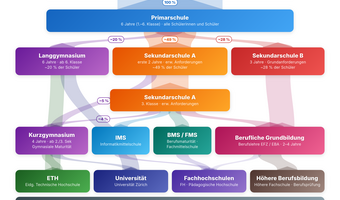
Schulsystem Zürich - einfach erklärt
Hier wird das Schulsystem Zürich einfach erklärt: Grundstruktur, einzelne Schulstufen, Schultypen und Abschlüsse, von der Frühförderung bis zur Quartärstufe.

Eignungstest Lehre: Welche Tests gibt es?
Eignungstest Lehre: Man unterscheidet berufsneutrale Tests, Eignungstests für bestimmte Berufsfelder, für bestimmte Berufe/ Lehren und betriebsinterne Tests.
Gleichzeitige Anmeldung für FMS- und BMS-Prüfung möglich?
Ob Anmeldung FMS BMS gleichzeitig möglich ist, erfahren Sie hier; auch, ob man sich noch zur Kurzgymi-Prüfung anmelden kann und welche Prüfungen einfacher sind.

Wertewandel Boomer vs Gen Z: Workaholics gegen Freizeitfans
Boomer vs Gen Z: Während Boomer zum Workaholic nahe Burnout tendieren, will Generation Z lieber sinnhafte Arbeit und Freizeit; wir erklären diesen Wertewandel.

Zweiter Bildungsweg, Studium: Lohnt sich das finanziell?
Lohnt sich zweiter Bildungsweg, dann Studium, finanziell, also der Weg über Erwachsenenmatura zur Universität, um mit Mitte 30 noch Anwalt oder Arzt zu werden?

Künstliche Intelligenz in der Schule unterrichten?
Sollte man Künstliche Intelligenz in der Schule unterrichten? Bislang steht KI nicht im Lehrplan. In Ausbildung und Beruf sind KI-Kenntnisse immer wichtiger.

Neue Berufsmaturitätsverordnung 2026: wichtigste Änderungen
Ab 1. März 2026 gilt neue Berufsmaturitätsverordnung 2026, deren wichtigste Änderungen wir vorstellen; auch ihr Entstehen aus dem Projekt Berufsmaturität 2030.

Mehr arbeitslose Akademiker: Trend kein Grund zur Sorge
Es gibt zwar immer mehr arbeitslose Akademiker in der Schweiz, aber Grund zur Sorge, dass man - z.B. wegen KI - nur noch im Handwerk Jobs findet, ist das nicht.

Kanton Zürich führt Kurzgymnasium an allen Langgymnasien ein
Alle Zürcher Langgymnasien ab Schuljahr 2029/2030 auch mit Kurzgymnasium: Rämibühl Literargymnasium und Realgymnasium, Hohe Promenade, Kantonsschule Rychenberg.
